

Burbn’s $1 Billion Bet — The 8 Features They Killed to Find Focus


Late one autumn evening in October 2010, in a small San Francisco apartment, Kevin Systrom was facing a crisis. His baby, what he had dedicated months of blood, sweat and tears, was hitting a wall. Burbn, the killer app he had created, had everything: location check-ins, gaming, photos. Everything was working, but nothing was clicking. What wasn’t obvious at the time was whether the problem was the product—or simply timing.
At a time when smartphone adoption was skyrocketing—doubling from 17% to 35% in 18 months—Systrom faced a critical decision. His investors, including AndreesenHorowitz, had invested $500K in Burbn and wanted him to launch as is. But Systrom saw the problem clearly: too much noise, not enough signal. He cut 8 of the app’s 9 features, keeping only photos.
Welcome to Instagram. And the rest is history.
Only in hindsight did the decision look obvious. Within a day, 25,000 users signed up. Within weeks, servers crashed. Within two months, there were a million users. Less than two years later, Facebook paid $1 billion. As Systrom later observed, the key to Instagram’s success: “It wasn’t about doing everything. It was about doing one thing perfectly. We had to refine focus, not reinvent the wheel.”
Refining Focus
Which brings me to this newsletter. Long-time readers will know that, for the last 3 years, I was writing bi-weekly newsletters under the banner The Future-Ready Advisor. My audience was financial advisors and financial services executives preparing to compete and succeed in a world of increasing competition, regulation and commoditization. I was pleased that my newsletter was growing in terms of reach and impact. But over time, something became clear. Whether I was writing for financial advisors or speaking with leaders in other industries, the underlying question was the same: how to move forward when the environment is changing faster than clarity can keep up.
So, like Kevin Systrom at Instagram, I refined my focus and thus the newsletter has now evolved into The Uncertainty E.D.G.E., focused on helping leaders navigate the tension between haste and hesitation in high-stakes, high-change environments—in financial advisory, in organizational transformation, in leading new initiatives, in managing complexity.
Welcome to the Second Edition under the new brand!
Systrom’s Agonizing Decision
Now let’s go back to Systrom’s agonizing decision. We can only imagine the turmoil and competing arguments he and his co-founder Mike Krieger, endured. They literally were navigating the tension between haste and hesitation when the path ahead was anything but clear.
What makes decisions like this so difficult isn’t a lack of intelligence or effort. It’s the tension that shows up when certainty disappears.
On one side is haste.
Haste shows up when progress itself starts to feel like safety. When doing something—anything—feels better than sitting with ambiguity. When momentum becomes its own justification. In Burbn’s case, haste could have meant continuing to add features simply because that’s what growth was supposed to look like. More check-ins. More gaming mechanics. More ways to compete. Forward motion without pause can feel decisive, but it often masks a deeper avoidance of uncertainty.
On the other side is hesitation.
Hesitation tends to wear the language of prudence. After all, there was real investments already made. Users existed, even if engagement was scattered. Investors had expectations. Competitors were expanding, not contracting. Cutting features felt risky—not just strategically, but reputationally. Waiting for more clarity felt reasonable. Sensible, even. But waiting also carried its own cost: attention diffused, identity blurred, and the real signal harder to see.
The hardest part is that neither haste nor hesitation feels obviously wrong in the moment.
Both can be justified. Both can be defended.
And both are familiar responses when the stakes are real and the data refuses to settle the question.
That’s the tension Systrom and Krieger were sitting inside—not between a good option and a bad one, but between two forms of risk.
In hindsight, it is easy to look at the decision and rationalize why it was the only decision to make. But that is what separates the Monday-morning quarterbacks from those who win championships. It’s not enough to analyze and second-guess decisions after the fact. When the stakes are high, those who win are the ones that can make the key decisions in a timely fashion while navigating the unavoidable tension between haste and hesitation.
The E.D.G.E. Framework
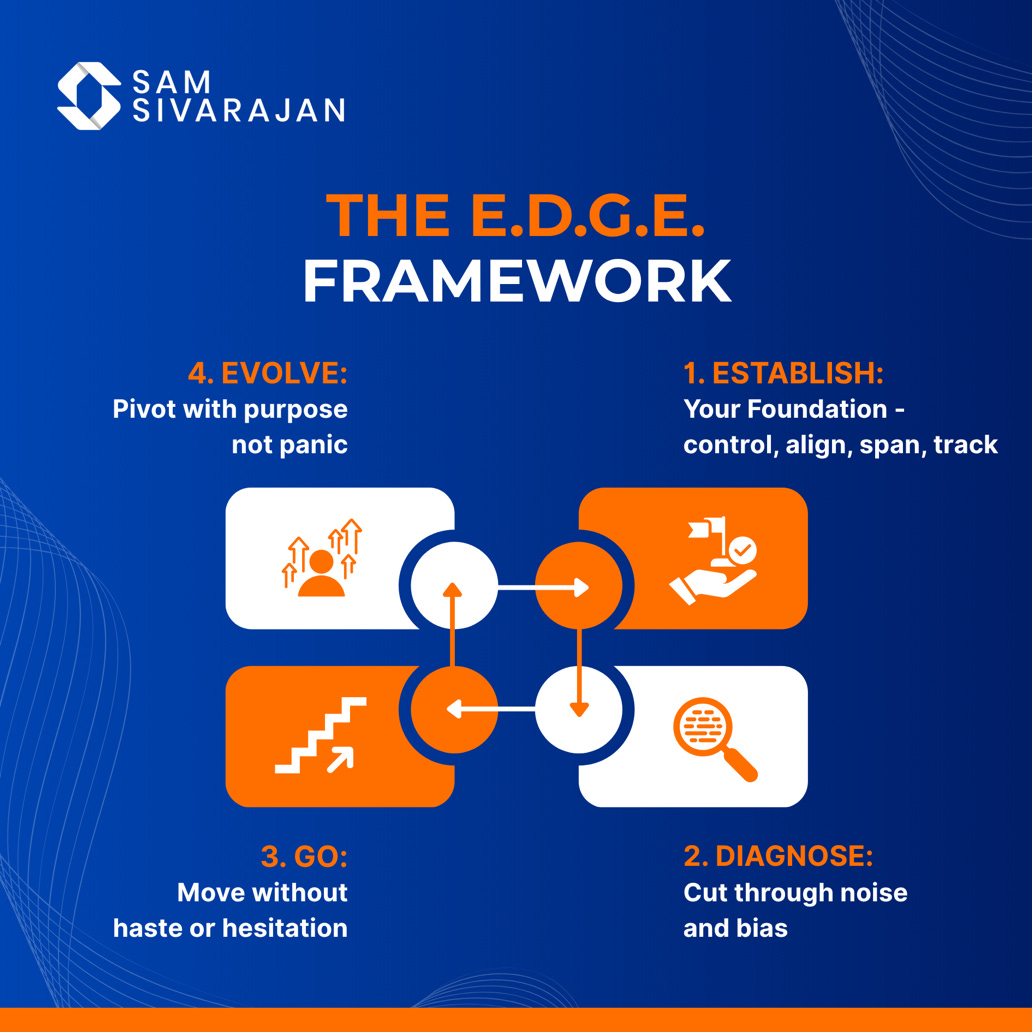
One way I think about decisions like this is through a simple rhythm I call E.D.G.E.—not as a checklist, but as a way of avoiding the pull toward haste on one side and hesitation on the other.
E.D.G.E. stands for:
Establish Your Foundation: focus on what you can control, align your actions with your priorities, span current challenges and long-term vision, track metrics that matter.
With your foundation established, you are ready to deal with uncertainty as it arrives:
Diagnose: see the problem clearly and objectively.
Go: move forward without haste or hesitation.
Evolve: pivot with purpose not panic.
The E.D.G.E. applied to Systrom’s Decision
Looking back, what stands out is how closely their decision aligned with a disciplined rhythm of judgment:
Establish:
· Control: they couldn’t control investors’ reaction, market uptake, etc.; they could control what features they launched with
· Align: their priorities were to build an app that maximizes user engagement; they needed to align their actions accordingly
· Span: they had solved their short-term challenge with the funds raised from investors, but they needed to bridge to their future vision of building a truly engaging and successful app
· Track: Burbn tracked everything: Check-ins, photos, games, plans, events.
Diagnose:
Systrom and Krieger found from their metrics that engagement was scattered. Only one metric stood out—photo engagement. Check out the E.D.G.E. guide for some of the frameworks and tools to help you make such diagnoses in your situation.
Go:
They then decided to optimize ONLY for that metric. Which is how they decided to abandon the other 8 features. Check out the E.D.G.E. guide for some of the frameworks and tools to help you make such GO decisions in your situation.
Evolve:
They didn’t rest on their laurels and instead kept an eye on the evolving market. Which is how they introduced videos, stories, shopping, reels, and how they agreed to be bought by Facebook. Check out the E.D.G.E. guide for some of the frameworks and tools to help you make such Evolve pivots in your situation.
The Result
The analysis by Systrom and Krieger would have revealed that most apps fail from feature bloat not feature poverty. Instagram’s success was primarily due to its unflinching focus on user engagement (their metric) with one key feature (photos). In contrast, companies that divide attention across too many priorities often struggle to build the kind of engagement that compounds. Instagram succeeded because they only did one thing, but they did it exceptionally well.
The lesson here is that in a noisy world, Focus is your Competitive Advantage.
Now, my story is not anywhere near as interesting or compelling as the Instagram story. But I applied the E.D.G.E. Framework in the same way, with the same tools, to reach my conclusion to pivot from The Future-Ready Advisor to The Uncertainty E.D.G.E. branding and to move from LinkedIn as my primary newsletter platform to Substack.
Living with Uncertainty
The reality is that whatever situation we are facing—launching a new app, rebranding a newsletter, dealing with the threats from AI in an advisory practice, or competing in the face of tariff and economic uncertainty—we must make decisions without the benefits of perfect information. After all, if everyone had a crystal ball, there would be no opportunity to set yourself apart and build something extraordinary. The E.D.G.E. isn’t a crystal ball. It’s a way of acting responsibly when there isn’t one. Because what makes winning leaders is not better information, but their willingness to move forward anyways while carefully navigating the tension between haste and hesitation.
You’re now reading The Uncertainty E.D.G.E.—same mission as before, sharper focus. Like Instagram cutting 8 features to find their billion-dollar clarity, I’m refining what works: helping you navigate the tension between hesitation and haste. The world won’t get clearer. But your judgment can.
If you want a deeper look at how I think about decisions like this, the E.D.G.E. Guide is available to subscribers of this free Substack.