

Simplicity Is a Superpower
(Especially in Uncertain Times)

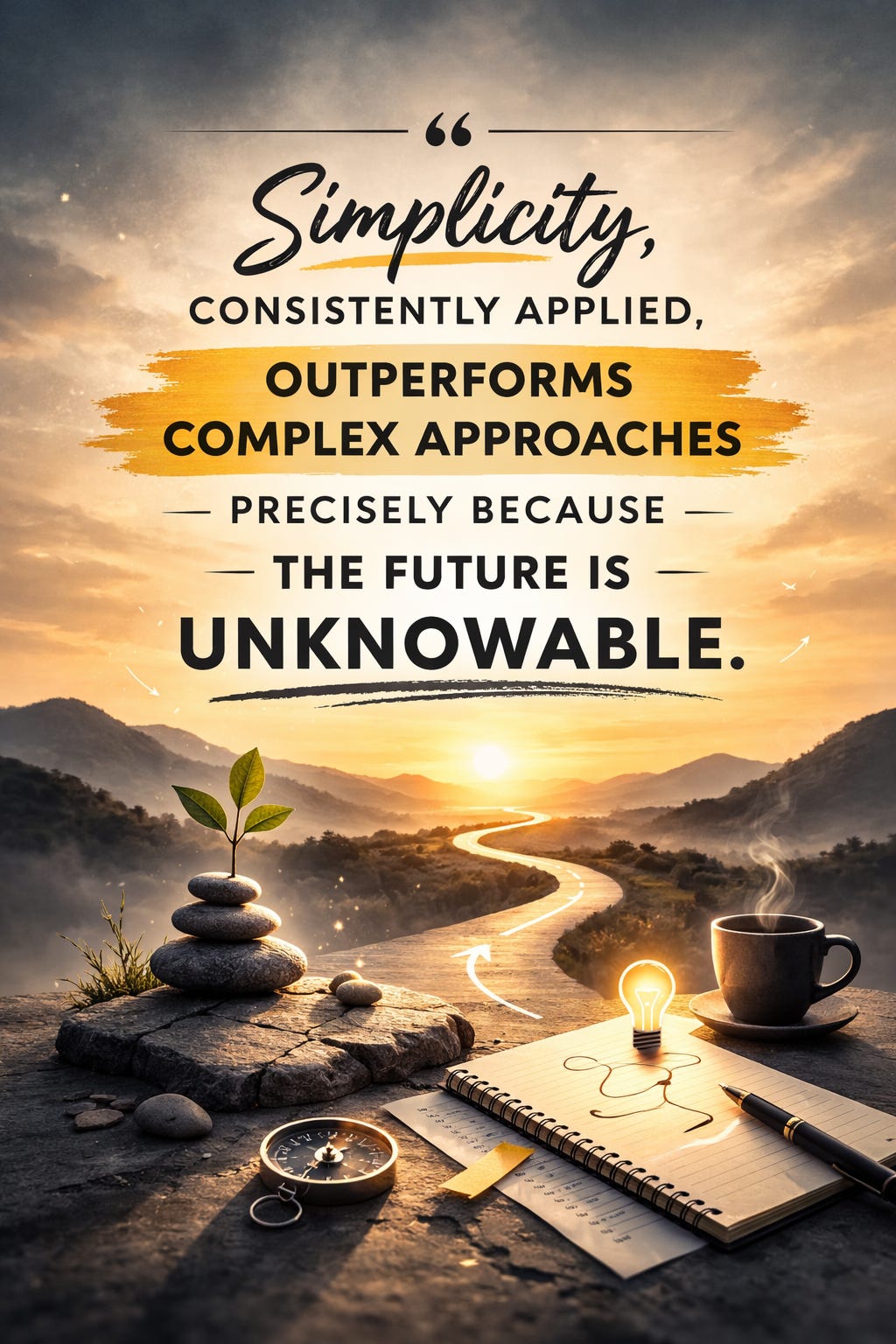
The tension between hesitation and haste often drives us toward complexity. We believe sophisticated strategies protect us from uncertainty. But decades of evidence reveal the opposite: simplicity, consistently applied, outperforms complex approaches precisely because the future is unknowable.
The Modest Genius of Steady Performance
David VanBenschoten ran the General Mills pension fund with a strategy so unremarkable it looked boring. Over 14 years, he never ranked above the 27th percentile in annual returns. Never below the 47th percentile either.
No headlines. No awards. No innovation prizes.
Yet when the 14-year period ended, his fund landed in the 4th percentile overall—outperforming 96% of his peers.
How? He avoided complexity. He avoided large losses. He maintained steady, above-average returns when everyone else chased outlier performance.
While other managers swung for the fences—sometimes winning big, often losing bigger—VanBenschoten played a different game entirely. He understood something fundamental about uncertainty: you can’t predict which year will deliver exceptional returns, but you can avoid the catastrophic mistakes that destroy long-term value.
This isn’t luck. It’s behavioral clarity in action.
The $5 Billion Annual Lesson in Complexity
The California Public Employees’ Retirement System (CalPERS) story highlights the opposite lesson.
As the largest public pension fund in the United States, managing more than US$500-billion, CalPERS employs sophisticated investment strategies and experienced managers dedicated to beating market benchmarks. Over a 10-year period ending 2020, CalPERS’s actively managed portfolio underperformed a simple passive benchmark by 114 basis points annually – consistently, in each of those 10 years. That was approximately US$5-billion per year in foregone returns.
As the CFA Institute study noted: “A sum that would fund a lot of pensions.”
CalPERS’s actual returns closely matched their own custom benchmark—the one they created and regularly tweaked. But when compared to the study’s straightforward, passively investable benchmark (a simple mix of broad market indexes like the Russell 3000, ACWI ex-US, and Bloomberg Barclays Aggregate), the underperformance was statistically significant.
All those resources. All that expertise. All those active management decisions.
Consistent underperformance against doing nothing but holding the index.
This isn’t a story about incompetence—CalPERS employs talented people. It is a story about how complexity can create an illusion of control in the face of uncertainty, while simultaneously introducing costs, risks, and failure modes that simple strategies can often avoid.
This pattern shows up beyond pension funds.
It shows up in leadership teams that add layers of reporting when revenue slows.
It shows up in organizations that launch new initiatives instead of doubling down on the 20% of activities that drive 80% of results.
It shows up in financial advisory firms that introduce increasingly complex portfolio strategies because clients expect sophistication—when what they truly need is discipline.
Complexity often masquerades as diligence. But in uncertain environments, it frequently compounds fragility.
Behavioral Insight: Why Complexity Feels Safer (But Isn’t)
Three cognitive patterns drive us toward complexity when facing uncertainty:
1. Action Bias Under Uncertainty
When outcomes are unpredictable, doing something—anything—feels better than doing nothing. Complexity signals effort. Effort signals control. But effort doesn’t equal results.
CalPERS’s extensive active management efforts weren’t driven by evidence they would outperform. They were driven by the psychological need to feel like they were doing something with all that capital. As CalPERS’s own investment consultant told their committee: “At any given time, around a quarter of external managers will be outperforming their benchmarks, but the question is whether those managers that are doing well are canceled out by other managers that are underperforming.”
The answer, over a decade, was unambiguous: the underperformers more than canceled out the outperformers.
2. Narrative Fallacy
Complex strategies generate compelling stories. “We identified undervalued opportunities through proprietary analysis and manager selection expertise” sounds more impressive than “we bought the index and waited”. But markets don’t reward better stories—they reward discipline in the face of randomness.
3. Hindsight Bias & Survivorship Bias
We remember the few complex strategies that worked (Warren Buffett’s Berkshire Hathaway) and forget the thousands that failed. This creates false confidence that we can be the exception—that our complexity will be the kind that pays off.
Meanwhile, simple strategies work consistently because they don’t require being exceptional. They require only being disciplined.
CalPERS represents what happens when institutional imperative meets uncertainty: the need to appear sophisticated overwhelms the evidence that simplicity works better.
Leadership Application: The E.D.G.E. Framework and Strategic Simplicity
How do leaders apply this insight to decision-making under uncertainty?
Establish: Focus on What You Can Control
VanBenschoten couldn’t control which years would deliver exceptional returns. But he could control:
Asset allocation consistency
Cost minimization
Risk management discipline
Rebalancing frequency
CalPERS couldn’t control whether their active bets would outperform.
But they could have controlled:
costs
complexity
organizational mission creep
Key question: Are you adding complexity to control the uncontrollable—or to execute what actually matters?
Diagnose: Separate Signal from Noise
The Pareto Principle (80/20 rule) applies ruthlessly in investing: 80% of long-term returns come from 20% of decisions—asset allocation, contribution consistency, cost minimization, tax efficiency.
Yet investors often spend 80% of their energy on the remaining 20%—tactical trades, timing strategies, manager selection, alternative assets.
CalPERS’s shift toward complexity exemplifies this. The research shows that just 9% of large-cap managers outperformed the S&P 500 over consecutive three-year periods. Yet institutions continue dedicating enormous resources to identifying which managers will be in that 9%—and then hoping those managers stay in that 9% for the next period.
Key question: What percentage of your effort addresses the core 20% that drives 80% of outcomes?
Go: Act on the Simple Truth
Even Harry Markowitz—the Nobel laureate who created modern portfolio theory’s complex mean-variance optimization framework—confessed he didn’t use it for his own retirement account:
“I should have computed the historical covariances of asset classes and drawn an efficient frontier... but I visualized my grief if the stock market went way up and I wasn’t in it—or if it went way down and I was completely in it. So I split my contributions 50/50 between stocks and bonds.”
The father of portfolio complexity chose simplicity for his own money. Why? Because simple strategies are easier to stick with when markets test your conviction.
Key question: Can you execute your strategy consistently for 10+ years, through multiple market cycles, without abandoning it?
Evolve: Learn from What Actually Works
Victor De Miguel’s research demonstrated that a simple equal-weighted portfolio (the 1/n rule) often outperforms complex mean-variance optimization—even when you know the true parameters of the return distribution.
Why? Because complex strategies are fragile. They optimize for past conditions that rarely repeat. Simple strategies are robust. They work across a wider range of futures.
CalPERS eventually acknowledged this reality. After years of underperformance, they began reviewing their use of external active managers and indicated they would use index strategies wherever they lacked “conviction” that active managers could add value.
Key question: Are you optimizing for the last market cycle—or building resilience for unknown futures?
The Insight: Complexity Is a Hedge Against Uncertainty That Often Backfires
Here’s the paradox: we add complexity precisely when uncertainty is highest—but that’s exactly when simplicity has the greatest edge.
Why?
Complexity multiplies failure modes. More moving parts = more ways to break. In uncertain environments, this is compounding risk rather than reducing it.
Complexity is harder to execute consistently. The more steps in your strategy, the more opportunities for behavioral errors, coordination failures, and drift.
Complexity obscures whether you’re winning or losing. Simple strategies provide clear feedback. Complex strategies let you rationalize poor performance indefinitely. CalPERS measured their portfolio performance against their own custom created benchmark, while underperforming the simple passive benchmark by $5 billion annually.
Complexity scales costs but rarely scales value. CalPERS employed thousands of investment professionals and spent billions on management. The passively investable benchmark required none of that infrastructure.
The lesson isn’t “never use complexity”.
The lesson is: complexity should be reserved for environments where simple strategies genuinely fail—not deployed as a default response to uncertainty.
What This Means for You
If you are a leader navigating organizational uncertainty:
Resist the urge to add unnecessary process, oversight, or initiatives when outcomes are unclear. Ask: “What’s the simplest version that could work?”
Complexity often signals fear masquerading as thoroughness. Simplicity signals confidence in what actually matters.
If you are an advisor helping clients navigate market volatility:
Your value isn’t in sophisticated strategies clients can’t understand or won’t stick with. It’s in helping them execute simple strategies consistently when their emotions scream to do otherwise.
The client who earns 7% annually for 20 years outperforms the client who earns 12% annually for 10 years and sits out in sheer panic for the next 10.
If you are an executive managing uncertainty:
The next time complexity feels necessary, ask: “Am I adding this because it improves outcomes—or because it makes me feel like I’m in control?”
Discipline beats sophistication. Consistency beats optimization.
Lead with Clarity. Adapt with Confidence. Win with Conviction.
David VanBenschoten never made headlines. He made history by avoiding the mistakes everyone else couldn’t resist.
CalPERS employs thousands of professionals and manages $500 billion with sophisticated strategies—and underperformed a simple index by $5 billion annually.
Uncertainty doesn’t reward complexity. It rewards clarity about what matters, discipline in execution, and the courage to stay simple when everyone else is chasing sophistication.
What will you choose?
This article draws on frameworks from The Uncertainty Edge: Lead with Clarity, Adapt with Confidence, Win with Conviction. For the complete EDGE framework and implementation tools, [get the book]