

Strategy Is a Commodity. Execution Is an Art.
Why leaders facing uncertainty don't win by finding better plans—they win by finding the few behaviors that actually work and making them stick.

In 1990, Jerry Sternin arrived in Vietnam with a mandate most leaders would have called impossible. The charity Save the Children had sent him to reduce child malnutrition in the countryside, where roughly two-thirds of children under five were malnourished. The Vietnamese government, weary of well-meaning foreign missions that produced reports and little else, gave him a deadline that doubled as a threat: show measurable results in six months, or your visa will not be renewed.
Sternin knew the academic answer and had scores of studies to support him. Malnutrition was a systemic problem; poor sanitation, contaminated water, poverty, lack of education. He also knew that answer was no use to him. He called it “True But Useless”. No outside expert was going to rebuild Vietnam’s sanitation infrastructure in six months on a shoestring budget.
So he asked a different question. In these same poor villages, facing the same conditions, were there any children who were noticeably healthier than their peers? Surprisingly, there were. And when he studied what their mothers did differently, the answer was almost embarrassingly simple. These mothers fed their children the same daily amount of food but in four small meals instead of two larger meals, fed them actively by hand, and added free, locally available foods (like tiny shrimp and crabs from the rice paddies and sweet potato greens) that most families dismissed as unsuitable for young children.
He hadn’t found a new strategy. He’d found behaviors that already worked; and his job was to get more people to do them, consistently. Within six months, malnutrition in those villages had fallen sharply. Within two years, the great majority of participating children were no longer severely malnourished.
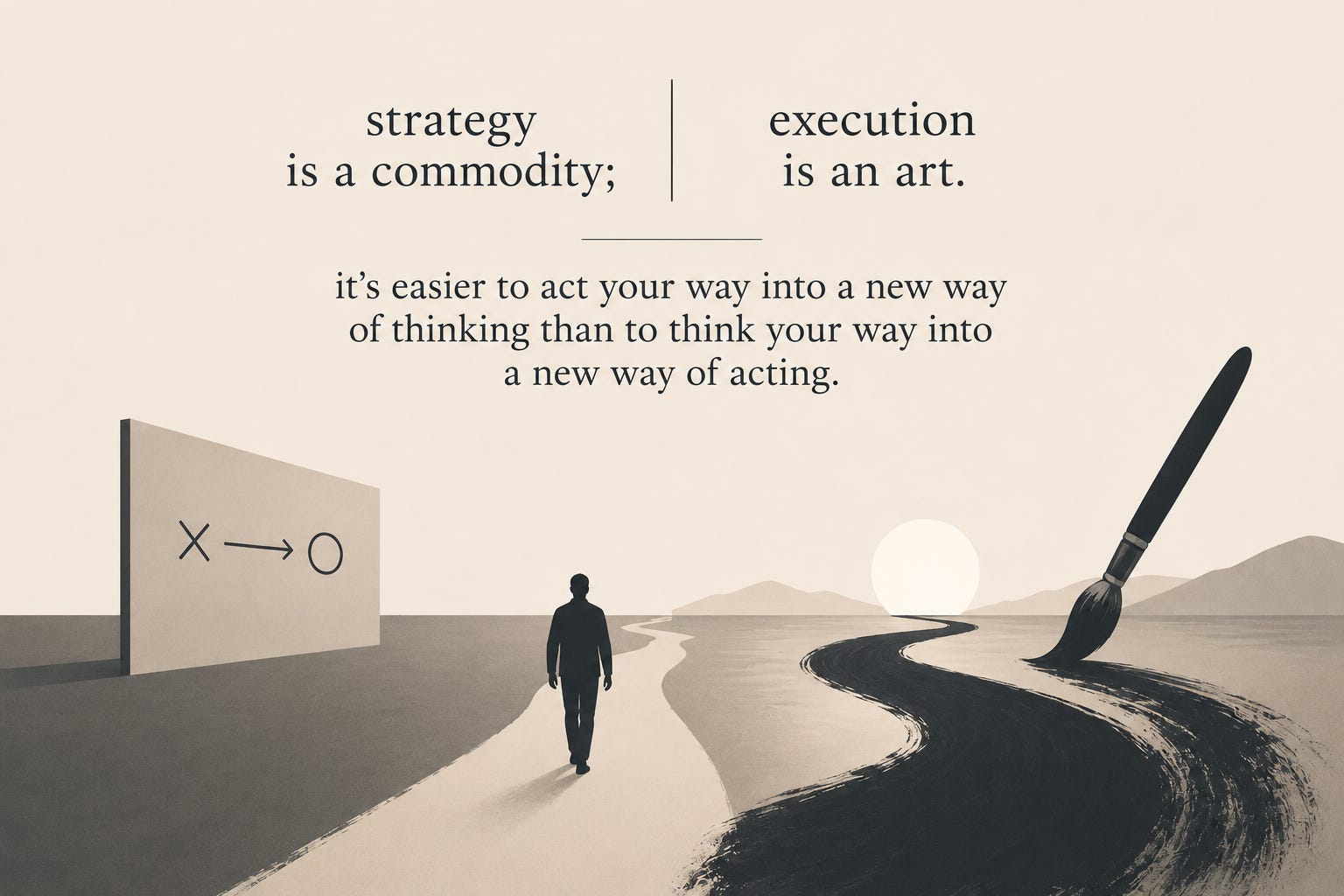
This is the tension at the heart of leadership under uncertainty. Faced with a problem too big to fully solve, most leaders do one of two things. They freeze, waiting for a clarity and certainty that never arrives. Or they reach for the sweeping transformation — the new strategy, the reorganization, the bold initiative — because doing something large feels like control. Sternin did neither. He found the few behaviors that worked and made them stick. Peter Drucker named the principle decades ago: strategy is a commodity; execution is an art.
The Consistency Premium
A 2023 study from McMaster University made the same point in an unlikely setting: the gym. Researchers, including co-lead author Jonathan McLeod, set out to find which training variables mattered most for building muscle: how much you lift, how often, which routine. The striking finding was how little those details mattered relative to a single factor: whether people actually stuck to the program. Get adherence right, and the rest is fine-tuning. Get it wrong, and the perfect plan is worthless.
Leaders instinctively resist this, because it sounds like permission to stop optimizing. It isn’t. It’s a statement about where the leverage lives. The strategy you can sustain beats the superior strategy you abandon; and under uncertainty, sustainability is the harder, rarer quality.
We’ve seen this in markets again and again. The investor who earns a steady 7% annually for twenty years ends up far ahead of the one who earns a brilliant 12% annually for ten years and then stays out of the market, panic-stricken, for the next ten. The edge isn’t in the return. It’s in the staying power.
If consistency is what matters, the real question becomes: how do you get people — clients, teams, yourself — to keep going when the payoff is distant?
Consider debt repayment. The mathematically optimal approach is the “avalanche”: attack the highest-interest balance first, because it costs you the most. It is absolutely correct on a spreadsheet. And it almost always routinely fails in practice.
In 2012, Kellogg researchers David Gal and Blakeley McShane analyzed how 6,000 people actually escaped credit-card debt. The strongest predictor of getting out of debt entirely wasn’t paying down the highest-interest balance; it was closing out the smallest balances first, regardless of interest rate. A 2016 Harvard Business Review study reached a similar conclusion: what keeps people paying is the feeling that they are finishing things, knocking out whole accounts and watching the list shrink.
This is the “snowball” method, and it works because it is mathematically suboptimal. Paying off a small balance barely dents your interest costs. But it delivers something the avalanche can’t: a completed win, early, that proves the plan works and makes you want to keep going. It rewards the right behavior. And as Dave Ramsey likes to say, personal finance is 20% head knowledge and 80% behavior.
The lesson travels far beyond debt. A rational plan people abandon underperforms an imperfect plan people finish. The leader who sequences early, visible wins, even modest ones, buys the one resource every long campaign runs out of first: belief.
Bright Spots: Amplify What Already Works
There’s a second move buried in Sternin’s story, and it’s the one most leaders miss.
When a problem feels overwhelming, the action-biased instinct is to invent or import a solution; bring in the consultants, launch the program, build something new. Sternin did the opposite. He assumed the solution already existed inside the system, being quietly practiced by the people succeeding against the same odds. Find those “bright spots”, understand what they do differently, and champion it across the organization.
This is faster, cheaper, and far more durable than an imported fix, for three reasons:
It’s already proven in context. The behavior works under your actual constraints; not in a case study from a different industry.
It’s locally credible. People adopt what their peers do far more readily than what an outsider prescribes.
It’s executable now. You’re amplifying existing behavior, not waiting on permission, budget, or a system overhaul.
Every organization has bright spots: the sales region quietly beating its targets with the same product and pricing as everyone else, the plant with half the defect rate, the team holding onto people in a high-churn function. The diagnostic question is rarely “What new thing should we do?” It’s “Who is already succeeding here, and what are they doing that we could adopt?”
Sternin captured the deeper truth in a single line: it’s easier to act your way into a new way of thinking than to think your way into a new way of acting.
The E.D.G.E. Framework: From Strategy to Execution
Establish: Control the Inputs, Not the System
Sternin couldn’t control poverty, the political climate, or a six-month clock imposed on him politically. He could control where he looked and which behaviors he reinforced.
Separate what you can influence — behaviors, sequencing, where attention goes — from what you can’t: the macro environment, the timeline you’ve been handed, the competitor’s next move.
Stop pouring energy into solving the whole system at once.
Key question: Are you trying to fix the entire system; or amplify the part of it that already works?
Diagnose: Find the 20% That Drives the Outcome
The conventional diagnosis of malnutrition was true but useless. The useful diagnosis was narrow: which specific, repeatable behaviors separated the healthy children from the rest?
Resist the elegant, comprehensive analysis that produces no action this quarter.
Identify the few behaviors that, done consistently, move most of the result; the four-meals-a-day equivalent in your own situation.
Key question: What is the smallest set of behaviors that, repeated, would move this outcome the most?
Go: Engineer the First Finishable Win
Purposeful action isn’t the grand launch. It’s the smallest concrete step that can be completed, and seen.
Sequence for an early, visible win: the individual’s small balance debt paid off, the village cooking group that showed results in two weeks.
Make it finishable in weeks, not years, so it generates evidence and confidence rather than fatigue.
Key question: What is a win your team could actually complete in the next few weeks?
Evolve: Make Progress Visible So People Don’t Quit
A single win is not enough. Momentum has to be renewed, or people drift back to the old behavior.
Build a cadence of visible milestones so progress stays felt, not merely claimed.
Use each win to surface new resources, options, and converts; then point them at the next step.
Key question: How do you make progress visible often enough that people stay in the race?
A Personal Note: Electrical Tape and the Power of Visible Progress
Years ago, I trained in Tae Kwon Do alongside my young daughter. The dojo was full of kids, and like any martial art, it demanded exactly the thing children find hardest: consistency over a long horizon. The obstacle was the belt system. Earning the next belt could take months. An eternity to a seven-year-old, and long enough that motivation quietly leaked away between gradings.
The dojo’s solution was almost comically simple. Electrical tape. Every few weeks, the instructors tested the kids on a small slice of the next level. Pass, and you earned a single stripe of tape on your belt. Three stripes, and the next belt was yours. Nothing about the curriculum changed. What changed was that a distant, abstract goal had been broken into visible, finishable wins; and the kids stayed with it.
I’ve since watched the same dynamic decide whether organizations sustain change. Building three wealth-advisory businesses through more than one market crisis taught me that teams rarely lose faith because the strategy is wrong. They lose faith because the goal is years away and nothing seems to be moving. The leader’s job is to supply the electrical tape: milestones close enough to feel, frequent enough to celebrate, and real enough to mean something.
Your Turn
The next time you face a problem too big to solve outright, resist both the analysis paralysis and the grand launch. Try this instead:
Find the bright spot. Who inside your system is already succeeding under the same constraints; and what, specifically, are they doing?
Name the 20%. Identify the few behaviors that drive most of the result. Set the rest aside for now.
Engineer the first win. Choose one finishable victory you can complete in weeks, not quarters.
Add the electrical tape. Set the next two or three milestones now, and decide how each one will be made visible.
The Japanese proverb says it plainly: fall seven times, stand up eight. The leaders who help their people keep standing up don’t do it with a better strategy. They do it by making progress impossible to miss — one finishable win at a time.
© The Uncertainty E.D.G.E. | Published every other Tuesday
If this resonated, I’d love to have you as a free subscriber — and forward this to a leader who needs to see around corners.
The Uncertainty E.D.G.E. is for leaders who are accountable for outcomes they can’t fully control — and want a clearer way to think when certainty won’t come.
Essays and conversations on decision-making under pressure, every other Tuesday. Join me at theuncertaintyedge.com.
If the human side of leadership is what draws you, I also write The Good Human Practice (thegoodhumanpractice.com) — on inner clarity and character for leaders called on to make those hard decisions under pressure.