

The Biggest Investment Decision You Never Made
Three companies. Three trillion dollars. And a quiet rule change that puts them in your portfolio whether you chose them or not

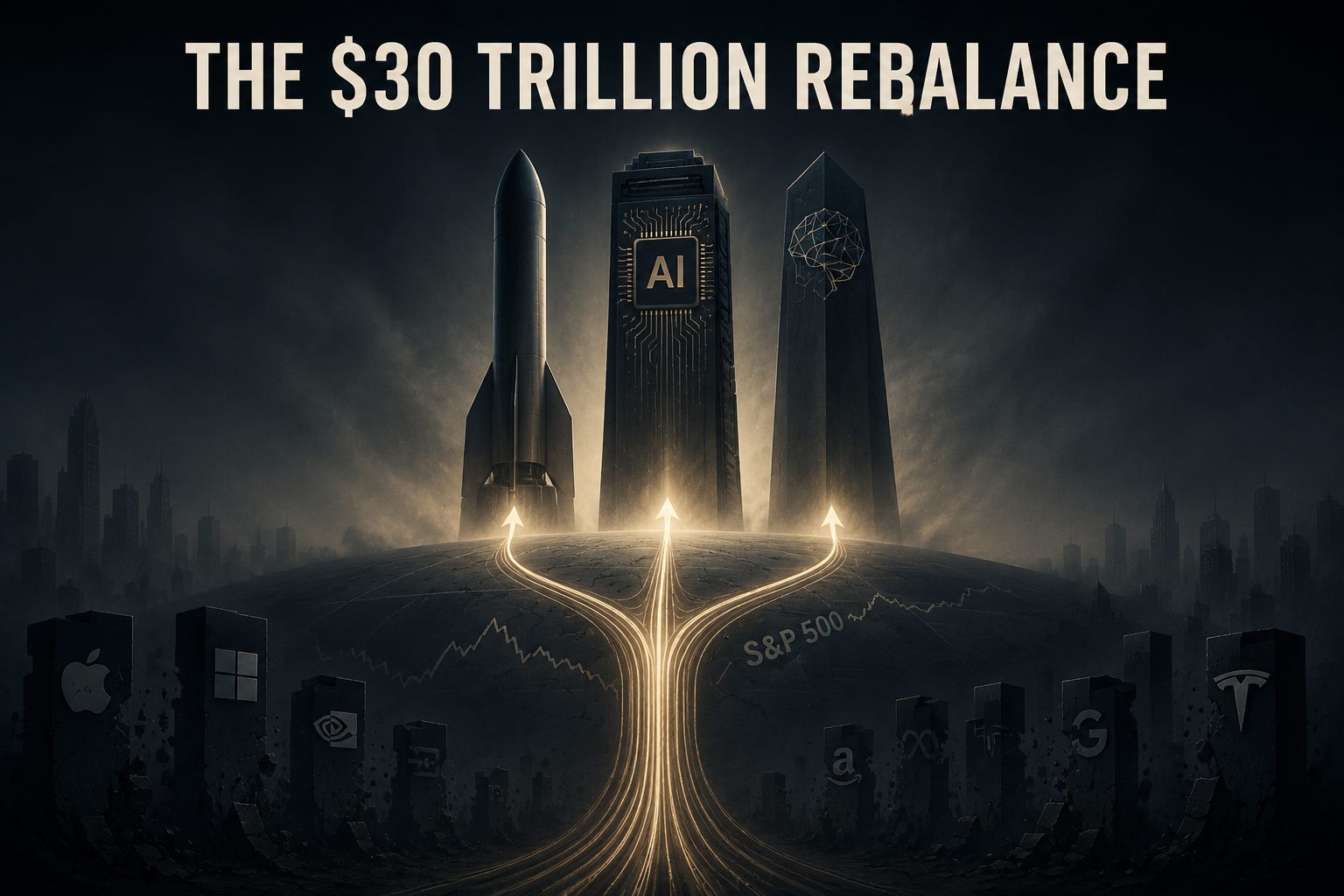
This article is arriving off my usual second-Tuesday schedule. With SpaceX listing next week — and OpenAI and Anthropic in the coming months — it couldn't wait.
Later this year, investors will be checking their portfolios, looking for familiar blue chips like Apple, Microsoft, Nvidia. These portfolios may look unchanged, but by year-end they could hold significant positions in three large, mostly unprofitable, recently listed companies. Not because their fund manager chose them, but because a market index did.
To much anticipation, and more than a little bit of hype, SpaceX, OpenAI and Anthropic are each targeting initial public offerings (IPOs), collectively valuing these companies at around three trillion dollars. Michael Burry (of Big Short fame) reportedly compared the coming three IPOs to the 2000 dot-com boom, arguing they could raise as much capital as roughly 300 internet and TMT IPOs did in 2000, after adjusting for inflation, and more than the entire U.S. IPO market raised in the decade from 2016 to 2025. These are the priciest IPOs for companies with no current profitability.
But the structural impact on investors is the major story behind these IPOs. Different index providers are simultaneously rewriting the rules to allow new issues to be included in the index at earlier stages and with less profitability. In 2026, three major index providers — S&P Dow Jones, Nasdaq, and FTSE Russell — introduced rule changes that fast-track newly listed companies into the index and waive or reduce profitability screens for megacap IPOs. S&P Dow Jones proposes to halve the IPO seasoning period from 12 months to 6 months and waive profitability requirements for megacap companies; Nasdaq introduced a “Fast Entry” rule effective May 1, 2026, allowing companies in the top 40 of Nasdaq-100 constituents (~$100B+) to enter the index in as little as 15 trading days after IPO; and FTSE Russell implemented a fast-entry rule on May 26, 2026, allowing eligible mega-IPOs to enter Russell US Indexes after just 5 trading days post-listing. This is massively significant. Passive funds now hold over 50% of US equity assets under management, with indexed mutual funds and ETFs accounting for roughly $13–15.4 trillion of US equity passive assets.
SpaceX plans to list in mid-June, targeting a $1.75 trillion valuation and aiming to raise over $75 billion in equity; more than double the capital raised in the ~$30 billion Saudi Aramco IPO, the previous largest raise, in 2019. SpaceX reported almost $5 billion losses on about $19 billion of revenues in 2025. While the Starlink business is profitable, the consolidated SpaceX business is not. Morningstar reportedly values the company at about $780 billion, less than half the target valuation.
OpenAI is preparing for a September listing at a trillion dollar plus valuation after the latest $850 billion valuation funding round. The company still reported losses of $9 billion in 2025, with an expected loss of $14 billion in 2026 and profitability not expected before 2030.
Anthropic is targeting an October IPO at an estimated trillion-plus dollar valuation. Their revenue is surging with an annualized run rate of $47 billion and their first profitable quarter expected in June 2026.
Investors should bear in mind that these IPO valuations are priced for perfection; everything has to go according to market expectations. The risks are not hypothetical. When SpaceX was valued at $12 billion in 2016, a launchpad explosion that grounded its fleet for four months was a serious but contained setback. Now, at a valuation of $1.75 trillion, a comparable failure would reverberate far beyond the company itself. Blue Origin’s second major launchpad explosion in two months demonstrated as much in May 2026, when the blast erased value across the entire space sector. The same logic applies to OpenAI and Anthropic: they don’t need to fail to disappoint investors, they only need to grow more slowly than the expectations baked into their valuations.
During the dot-com boom, for example, Cisco briefly became the world’s most valuable company, trading at valuations that implied astronomical growth expectations. Cisco then lost most of its value when the bubble burst, and its stock did not trade back above its March 2000 peak until December 2025. Patient investors had to wait 25 years to recover their investment.
This has implications even for passive investors. Index funds have to rebalance their fund investments regularly, reducing existing holdings to replicate the updated index. A retiree’s portfolio, already holding Apple and Microsoft, will quietly get re-weighted toward three unprofitable companies priced at peak valuations. They didn’t choose this. The index chose it for them.
We have seen this before. When Tesla entered the S&P 500 in December 2020, index funds had to buy approximately $80–85 billion worth of Tesla stock in a single rebalancing event — the largest in S&P history, surpassing the prior record of $50.8 billion. Now multiply that by three companies, entering at potentially higher valuations, within a compressed window of months. SpaceX alone at $1.75 trillion would require index funds to absorb a position substantially larger than the Tesla rebalancing.
None of this is an argument against passive investing. It is pointing out that the infrastructure passive investors rely on, the rules governing what goes into an index and when, is being quietly reshaped to accommodate specific companies at specific valuations. And the people who bear the risk of these changes are the same people who were told the whole point of passive investing was that nobody was making subjective and risky decisions for them.
What should a thoughtful investor be watching? Start with your own investment. Most passive investors don’t know the inclusion criteria for the index their retirement is pegged to; and when those criteria change, as they are changing now, the composition of your portfolio changes without your input. One option is to choose equal-weighted versus market-capitalization-weighted ETFs. The latter’s holdings are skewed towards the largest companies in the index; the former isn’t. Second, watch for concentration risk: three mega-IPOs entering major indices within months of each other, at combined valuations of about $3 trillion, will mechanically increase exposure to a handful of unprofitable names, and “diversified” may not mean what it did six months ago. Finally, understand the asymmetry. These stocks are priced for perfection; the upside is already baked into the price, while the downside, whether a technical failure, a revenue miss, or a regulatory shift, is not. And when passive funds cannot sell without deviating from their mandate, any repricing affects everyone in the index, not just the company that stumbled.
The four most expensive words in history are “this time is different.” Investors would do well to remember that these words have proven false every time before.
As John Kenneth Galbraith said in his classic work, The Great Crash, 1929: This is a world inhabited not by people who have to be persuaded to believe but by people who want an excuse to believe.