

The Decision Tax: Why January Plans Fail by March

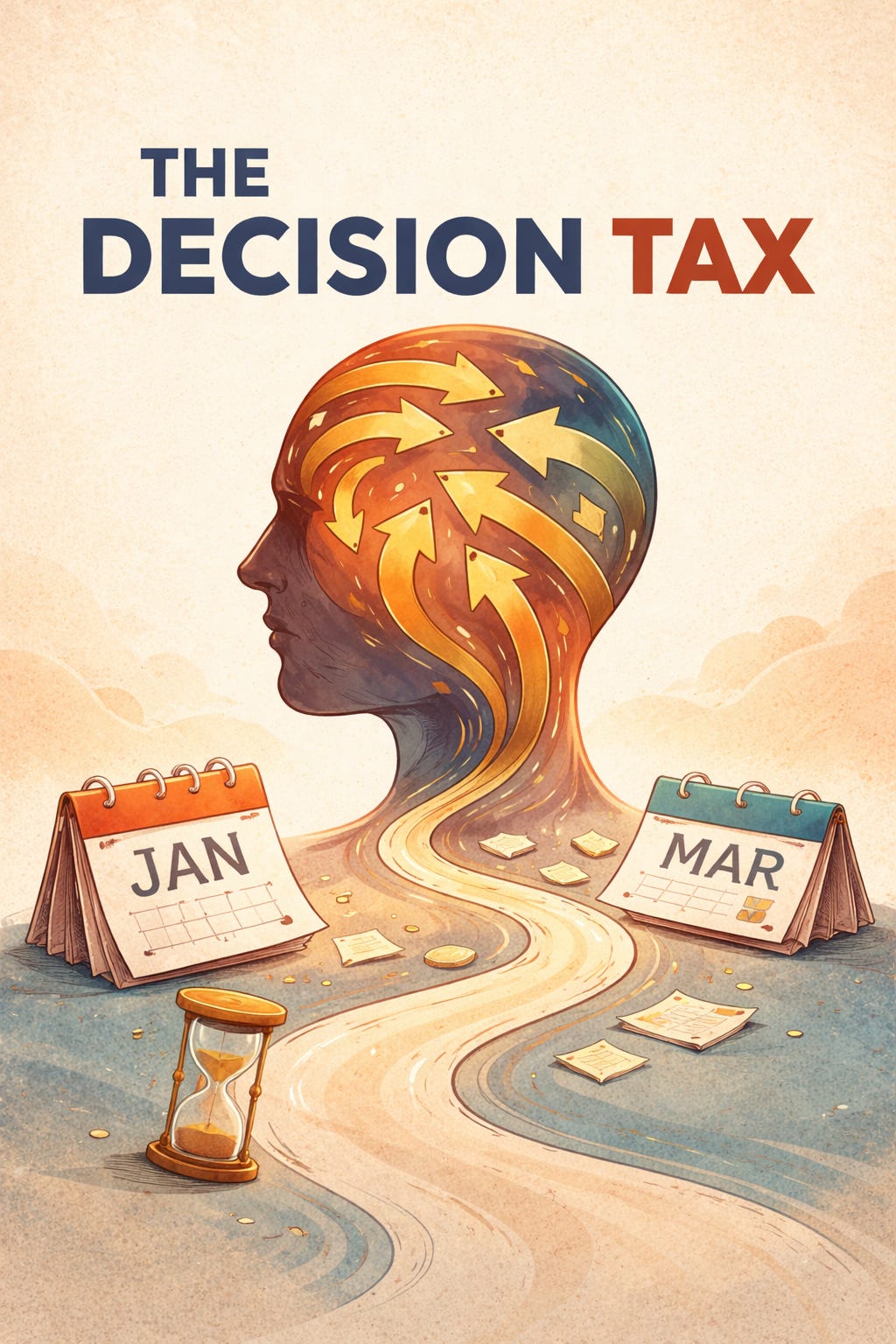
In January 2024, a CEO I advised faced the following decision.
Launch a new financial advisory business model aimed at younger clients—requiring meaningful technology investment, retraining advisors, and potentially cannibalizing existing high-value relationships. Or do more research, wait for more market clarity and see if there was a real demographic shift that wasn’t going away.
Thanks for reading Sam’s Substack! Subscribe for free to receive new posts and support my work.
The business case was compelling.
The timing was uncertain.
The board wanted commitment.
The CFO wanted proof of concept.
For the CEO, both taking action and waiting for more information carried real consequences.
This decision pattern is pretty typical: strategic initiatives that require commitment before clarity arrives.
Markets are uncertain.
Data is incomplete.
Stakeholders want direction.
Waiting feels risky.
Moving too quickly feels even riskier.
Most leadership advice treats this as a confidence problem: “Trust your instincts.” “Be decisive.”
But the real challenge isn’t confidence. It’s judgment under uncertainty—deciding when both haste (rushing ahead to relieve discomfort) and hesitation (waiting for certainty that won’t come) carry downside you can’t afford.
The start of a new year amplifies this tension.
The Predictable Failure Pattern
Here’s what typically happens in many companies:
Q1: Launch ambitious initiatives with clear targets
Q2: Early results disappoint, but we push harder
Q3: Quietly scale back while maintaining the narrative
Q4: Abandon or dramatically revise what we committed to in January
The problem isn’t execution. The problem is that we confuse goal-setting with judgment.
A market expansion. An organizational restructure. A technology migration. New Year’s Resolutions to finally get in shape.
The specifics change, but the pattern holds: we commit without contingency, set goals without thresholds, and assume confidence will power us through uncertainty.
By March, we’ve been punched in the mouth, as Mike Tyson famously observed. By June, we’re managing consequences we should have anticipated.
Why This Happens
Behavioral science reveals the underlying mechanism: when people think about future outcomes, their brain activity looks remarkably similar to when they think about strangers. We see our future selves as essentially other people. And the consequences of our decisions as essentially happening to other people.
This creates three predictable distortions:
Present Bias: We overweight immediate pressures (board expectations, quarterly targets) and systematically underweight future consequences that feel abstract.
Planning Fallacy: Teams underestimate how long initiatives take and overestimate their capacity to execute—especially after a demanding Q4.
Commitment Without Contingency: Organizations set ambitious targets without explicit plans for when reality diverges from the plan.
The result is that by March, initiatives are off track. By June, they’re being quietly abandoned.
What You Control vs. What You Don’t
Most January decisions fail because people treat uncertainty as something to overcome rather than something to manage.
You cannot control market conditions, competitor responses, how quickly teams adapt, whether key people stay or leave, or what the board will prioritize six months from now.
You can control the threshold at which you’ll revisit the decision, the specific indicators you’ll monitor, your response if assumptions prove wrong, the reversibility of your commitments, and how explicitly you communicate uncertainty to stakeholders.
Implementation intentions bridge this gap.
An implementation intention is not a goal. It’s a pre-commitment, grounded in behavioral science, about what you’ll do when specific conditions occur.
The structure is simple: “If X happens, then I will do Y.”
The power comes from creating these commitments before you’re in the moment of high pressure, incomplete information, and competing demands.
How This Works in Practice
Consider a CEO pursuing his first strategic acquisition. Strong rationale. Board alignment. Pressure to close before another buyer emerges.
Week 4 of due diligence: Multiple red flags surface. The top three clients represent 68% of revenues, not the disclosed 40%. And their contracts are up for renewal in 6 months. Integration would cost $2M more than projected and take 18 months instead of 9. Undisclosed technical incompatibilities emerge.
The investment bankers say this is normal. “Every deal has warts. Price it in and move forward.”
But before this process began, the CEO had created implementation intentions:
“If customer concentration exceeds 50% from fewer than 3 customers, then I will pause negotiations and model the risk explicitly. If we cannot secure renewal commitments before close, then I will not proceed regardless of price concessions.”
“If integration costs exceed our estimate by more than 25%, or timeline extends beyond 12 months, then I will reassess whether the strategic value justifies the operational disruption.”
“If our teams identify fundamental incompatibilities that weren’t disclosed, then I will treat this as a governance signal—not just a technical issue.”
By Week 8, all three potential triggers had become real issues.
The CEO walked away.
Not because the deal failed. Because the decision process worked as designed. Walking away wasn’t failure—it was the implementation intention working.
Failure would have meant closing the deal in March, then spending 18 months integrating incompatible systems while two major customers churned, all while pretending to the board it was going according to plan.
The same structure shows up in our personal lives.
Consider retirement investing. In January, discipline is easy when making plans in quiet market conditions. But by March, volatility has arrived. Your portfolio is down 18%. Your brother-in-law moved to cash and avoided the decline. Action feels urgent.
The question isn’t what you believe now. It’s what you decided in advance:
“If my portfolio drops 15% or more, then I will stay off my investment app and wait 48 hours before making any decisions. After 48 hours, I will review my written investment policy statement. If I still feel compelled to change course, then I will call my advisor to discuss whether my circumstances have changed—not whether the market has changed.”
You’re not eliminating the obstacle. You’re just preparing for it before the pressure arrives.
About This Newsletter
Which brings me to my own “If… then” decision.
For the last three years, I wrote under the banner The Future-Ready Advisor—focused on financial advisors and financial services executives navigating regulation and commoditization.
I was happy with the newsletter’s growing reach and impact. But over time, something became clear. Whether I was writing for financial advisors or speaking with leaders in other industries, the underlying question was always the same.
How do you move forward when the environment is changing faster than clarity can keep up?
Here was my implementation intention: If my newsletter audience is changing in terms of what they are looking for, then I will evolve my newsletter to meet their needs in terms of what I write about.
So this newsletter has evolved into The Uncertainty E.D.G.E.—helping people who make decisions that matter navigate the tension between haste and hesitation in high-stakes, high-change environments.
In financial advisory. In organizational transformation. In leading new initiatives. In managing complexity.
Welcome to the first edition under the new brand.
Putting this into Practice
You likely have at least one significant decision facing you in January.
Before you decide, answer these questions:
1. What is the decision? State it precisely. Not “should we pursue growth” but “should we enter Market X in Q1 vs. Q3 vs. not at all.”
2. What are you not controlling for? List the external factors that could make this decision succeed or fail, regardless of execution quality.
3. What’s the punch in the mouth? What specific obstacle can you already anticipate? When it happens, what will you do instead of the default response?
Then create at least one implementation intention:
“If [specific trigger occurs], then I will [specific action] instead of [default response].”
Write it down. Share it with your team. When the moment comes—and it will—you’ll be ready.
Because in decision-making under uncertainty, success isn’t determined by the strength of your commitments. It’s determined by how well you prepared for the moment when reality will punch you in the mouth.
The Uncertainty E.D.G.E.™ helps people act with clarity and judgment when certainty is impossible. Subscribe for frameworks, not just inspiration. Reply with your questions—I read every message.