


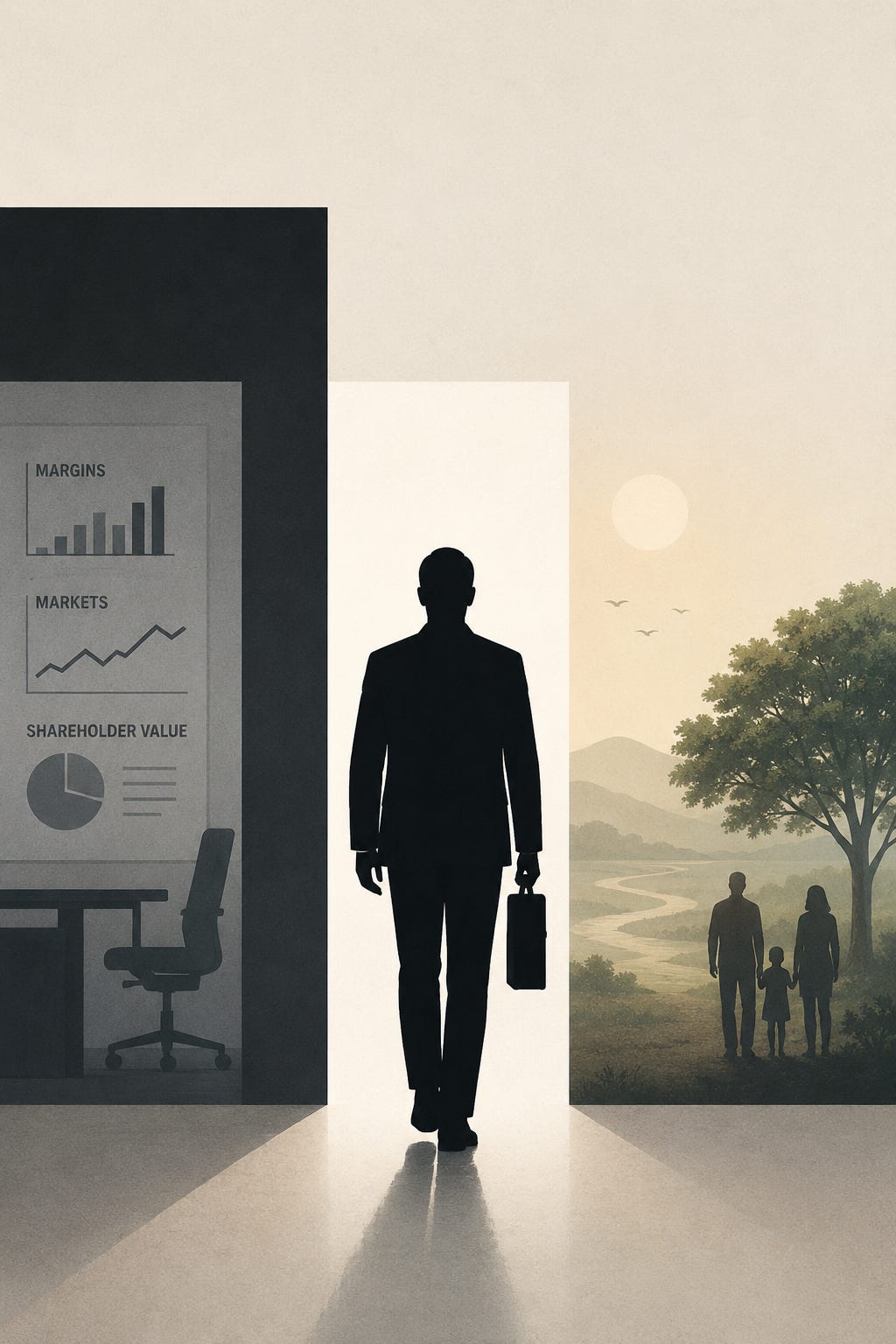
There is a kind of professional discipline that leaders have been trained to perform. You walk into the building and become a slightly different person — one who speaks in the language of margins and markets, who sets aside the parent lying awake wondering what world their child will inherit, who sets aside the citizen unsettled by what they read at breakfast. You compartmentalize. You focus. You call it professionalism.
It may be one of the most expensive habits in modern leadership.
The Macro Is Inside the Building
Ask most senior executives what keeps them up at night and they describe a micro world: tariff exposure, talent scarcity, competitive disruption, the next board presentation. These pressures are real. But for most businesses, they are not the primary threat on the horizon. The primary threats are macro — systemic, structural, and already in motion.
We are living through what complexity theorists call a polycrisis: a cluster of interconnected global failures in which the interaction of crises produces harms greater than the sum of their parts. Climate change. Rising inequality. The erosion of the institutional frameworks that underpin commercial life. The standard executive response is to treat these as someone else’s problem to deal with — the domain of governments, regulators, and NGOs, while the real work of running a business gets their focus.
Rebecca Henderson argues that this response is not just ethically inadequate, it is strategically incoherent. Henderson is not some community advocate railing from outside against the system — she is the John and Natty McArthur University Professor at Harvard, holding a joint appointment across General Management and Strategy at Harvard Business School, with twenty-one years previously at MIT’s Sloan School. A mechanical engineer by training, with a doctorate in business economics, and a former management consultant to legacy companies in transformation, her book Reimagining Capitalism in a World on Fire was named a Financial Times Best Business Book of the Year. When she makes the business case for engaging with systemic risk, she is speaking from capitalism’s intellectual centre, not its periphery.
Her argument is clear: companies have spent decades externalizing their costs onto shared systems — the atmosphere, public health infrastructure, the labour market — and those systems are now degrading in ways that are eliminating the conditions on which future profit depends. You cannot extract indefinitely from a limited and shared resource you depend on. The macro is not outside the building. It is the very foundation the building sits on.
The Cost of Climate in Black & White
Abstract warnings about long-term risk tend to dissipate in the presence of quarterly targets. So let’s be specific.
The Potsdam Institute for Climate Impact Research, in a study published in Nature in 2024, estimated that climate change will cost the global economy approximately $38 trillion per year by mid-century — roughly 17 percent of projected global GDP — even if every emissions commitment already made is honored. Harvard economists Adrien Bilal and Diego Känzig found that every additional 1°C of global warming reduces world GDP by more than 20 percent in the long run — equivalent to the Great Depression experienced permanently rather than temporarily. Swiss Re, whose entire business depends on accurate risk modeling, estimated losses of approximately $23 trillion in annual GDP by 2050 under current trajectories.
For decades, the standard rebuttal was reassuring: technology will solve it. Efficiency gains, renewable energy, carbon capture — the ingenuity of the market would find a path. That argument gets harder and harder to sustain. Global data centers consumed approximately 415 terawatt-hours of electricity in 2024 — equivalent to the annual demand of Pakistan — and that figure is projected to more than double by 2030. A typical AI data centre uses as much electricity as 100,000 households. Google’s 2023 greenhouse gas emissions were 48 percent higher than in 2019, driven primarily by data centre expansion.
The hardware itself compounds the problem. Manufacturing the GPUs on which AI runs requires extraction of rare earth minerals — cobalt, lithium, nickel — in processes that are energy-intensive, frequently toxic, and conducted largely in communities with the least political power to resist.
The technology that was supposed to solve our climate problem is running on the same energy infrastructure it was supposed to replace.
Inequality: The Market You Are Gradually Shrinking
The second thread of the polycrisis shows up on both sides of the ledger simultaneously — in the workforce and in the demand picture.
On the workforce side, financial insecurity does not stay at home when employees arrive at work. Research by Sendhil Mullainathan and Eldar Shafir found that financial stress imposes a persistent cognitive burden equivalent to losing a full night’s sleep. Workers who cannot afford healthcare, who carry the burden of economic precariousness, do not perform as well, engage as deeply, or stay as long. A business that minimizes wage costs while maximizing the financial anxiety of its frontline workforce pays for that decision in turnover, productivity, and engagement — in ways that never appear on the P&L.
On the demand side, extreme inequality contracts the market. This is the calculation Henry Ford made in 1914 when he paid his assembly workers wages of five dollars a day, double the going rate — not out of charity, but because he wanted his workers to afford the cars they were building. In January 2015, Mark Bertolini made a structurally identical decision at Aetna, raising the company’s minimum wage from $12 to $16 an hour for approximately 5,700 employees. When he examined data on his frontline staff, he found many were enrolled in Medicaid and relying on food stamps. “Here we are a Fortune 50 company,” he told CNBC, “and we’re about to put these people into poverty.” He estimated the $26 million yearly cost could generate approximately $120 million annually in reduced turnover and retraining costs. During his tenure, Aetna’s stock moved from under $30 to over $200 a share.
The numbers tell the story plainly. The top 10 percent of earners now account for just over 49 percent of US consumer spending, up from 43 percent in 2020. Everyone else — roughly three-quarters of the population — faces stagnant wages, depleted savings, and costs for housing, food, and energy that have risen faster than income for the better part of the past five years. The K-shaped recovery since Covid has not corrected. It has calcified.
For most businesses, this is not background noise. It is a structural contraction of the addressable market. Unless your business model is explicitly designed to serve the ultra-wealthy — Bugatti supercars, Hermès handbags, private aviation — the shrinking of the middle is shrinking your customer base. And even the luxury end offers no safe harbor. The global luxury consumer base fell from about 400 million in 2022 to about 330 million in 2025, a decline of roughly 70 million people, with the contraction concentrated among aspirational buyers. The business leader who reads rising inequality as a social problem rather than a commercial one is misreading their own financial statements.
Here too, technology has not been the equalizer it was promised to be. Venture capital leaders donated more than $283 million during the 2024 US election cycle — three times the 2020 figure — directed largely toward deregulation, tax preferences, and antitrust protection. Tech companies are lobbying to block state-level AI regulation, secure access to public data, and obtain tax breaks unavailable to ordinary businesses. The technology revolution has concentrated unprecedented wealth in an extraordinarily small number of hands, and those hands are actively working the political system to keep it that way.
The Invisible Infrastructure You Are Standing On
What makes it rational to sign a contract and expect it to be enforced is not the virtue of the counterparty — it is a legal system with the independence to compel performance. What makes it rational to invest abroad is not goodwill — it is property rights, arbitration frameworks, and legal predictability that rest on precedent rather than the preferences of whoever holds power. The World Justice Project’s Rule of Law Index shows a global pattern of institutional deterioration for the eighth consecutive year, with 68 percent of countries declining in 2025. Atlantic Council research finds the rule of law to be the single strongest correlate of economic growth across 164 countries over thirty years of data.
And once again, technology is not a bystander. It is an active participant in the erosion. The mergers that have consolidated media, communications, and platform power have been waved through by regulatory bodies whose independence has been progressively weakened — in some cases, by the very companies seeking approval. The TikTok divestment saga illustrated how the line between regulatory oversight and political negotiation has become nearly invisible. Tech companies have mounted extensive lobbying campaigns aimed at shaping or weakening enforcement of the EU’s Digital Services Act, while critics argue that large platforms increasingly deploy antitrust rhetoric strategically to preserve dominant market positions rather than expand competition.
A company that treats institutional erosion as someone else’s concern is quietly deteriorating the very ground it stands on. When institutions weaken, the costs show up in risk premiums, shortened planning horizons, and the growing advantage of buying political access over building competitive merit.
The Divided Self — And What It Costs
None of this explains why capable, intelligent leaders continue to treat these systemic risks as external to their strategic responsibility. The data is not ambiguous. The business case, as Henderson has documented extensively, is strong and there to be made.
What is missing is permission.
For nearly half a century, the dominant ideology of corporate life has been supplied by a single essay. In September 1970, Milton Friedman published a piece in the New York Times Magazine under the title “The Social Responsibility of Business Is to Increase Its Profits”. His argument was unambiguous: a corporate executive is an agent of the shareholders who employ them, and any deviation from the goal of maximizing their returns — spending on social causes, reducing pollution beyond legal requirements, paying workers more than the market demands — is a form of theft. The executive who acts on broader social obligations, Friedman wrote, is “in effect imposing taxes” on shareholders without their consent, undermining the foundations of a free society. Bringing personal values into professional decisions was not, in his framing, an act of integrity. It was an act of subversion.
The essay gave generations of business school graduates moral cover for a narrowed self. If the only legitimate goal was shareholder value, then the parent, the citizen, and the person with a conscience about the future were not just irrelevant to business decisions — they were actively dangerous. To act on personal values was to betray your fiduciary duty. The result was exactly the professional persona the doctrine was designed to produce: strategic, analytical, competitive — and with the rest of the person’s self left at the door.
What is less often noted is how selective that reading of Friedman actually was. Even he acknowledged that profit maximization must occur within “the rules of the game, which is to say, engage[s] in open and free competition without deception or fraud”. He was not, by his own account, licensing the externalization of costs onto the public, or the political capture of the regulatory systems that set the rules. The Friedman doctrine that corporate culture absorbed was a misreading even of Friedman. And it was a truncation that conveniently served those who stood to benefit most from it.
The philosopher Jean-Paul Sartre had a name for what Friedman’s doctrine produced. He called it bad faith — the condition of playing a role so completely that you deny having any other self. His illustration was the waiter who performs being a waiter with such precision that he ceases, in his own mind, to be a person who also happens to wait tables. The leader who says “my only obligation is shareholder value” and uses that to soothe their conscience, calm their parental anxiety, dismiss their citizen’s unease, is doing the same thing. It is not rigor. It is self-deception with a legal citation attached.
The parent who lies awake worrying about the world their child will inherit and the executive who decides on a share buyback to increase the stock price or price climate risk into capital allocation are the same person. When they are permitted to be the same person at the strategy table, better decisions follow.
The Permission That Was Always There
There is a point in Henderson’s argument that directly answers the fiduciary objection most commonly deployed against this kind of thinking.
When a publicly traded company receives a hostile takeover bid, its board frequently rejects the offer — even at a substantial premium to current share price — often because they believe the offer undervalues the long-term prospects of the company. This action is protected by the business judgment rule, which presumes that directors acting in good faith to protect the company’s long-term interests are not liable for outcomes that later prove unfortunate.
If a board can lawfully reject a premium acquisition to protect long-term value, on what logical basis can that same board dismiss the material risks posed by climate exposure, labor instability, or institutional erosion? These are financial risks — recognized as such by insurers, institutional investors, and central banks. The fiduciary argument against engaging with them has always been a narrow reading of what fiduciary duty actually requires. The permission is not missing from the law. It is missing from the culture.
What This Asks
The business rationale for engaging seriously with the polycrisis is the same rationale that informed Ford’s and Bertolini’s wage decisions and every board that has sacrificed short-term returns to protect long-term value. You cannot sustainably profit from a system you are helping, even inadvertently, to destabilize.
But it asks something more personal: that leaders stop maintaining the fiction that their professional and human selves do not know about each other. The deepest uncertainty leaders face today is systemic — and it cannot be navigated by a curated half-person. It requires the whole: someone who brings their full intelligence and full conscience to the decisions that matter most.
The leader who checks their whole self at the door is not being rigorous. They are being diminished. And the organizations they lead are diminished with them.
© The Uncertainty E.D.G.E. | Published every other Tuesday
If this resonated, I’d love to have you as a free subscriber — and forward this to a leader who needs to see around corners.
The Uncertainty E.D.G.E. is for leaders who are accountable for outcomes they can’t fully control — and want a clearer way to think when certainty won’t come.
Essays and conversations on decision-making under pressure, every other Tuesday. Join me at theuncertaintyedge.com.
If the human side of leadership is what draws you, I also write The Good Human Practice — on inner clarity and character for leaders called on to make those hard decisions under pressure.