

Thriving Businesses Don’t Feel Sick — Until It’s Too Late.
Netflix’s $20 Billion Lesson

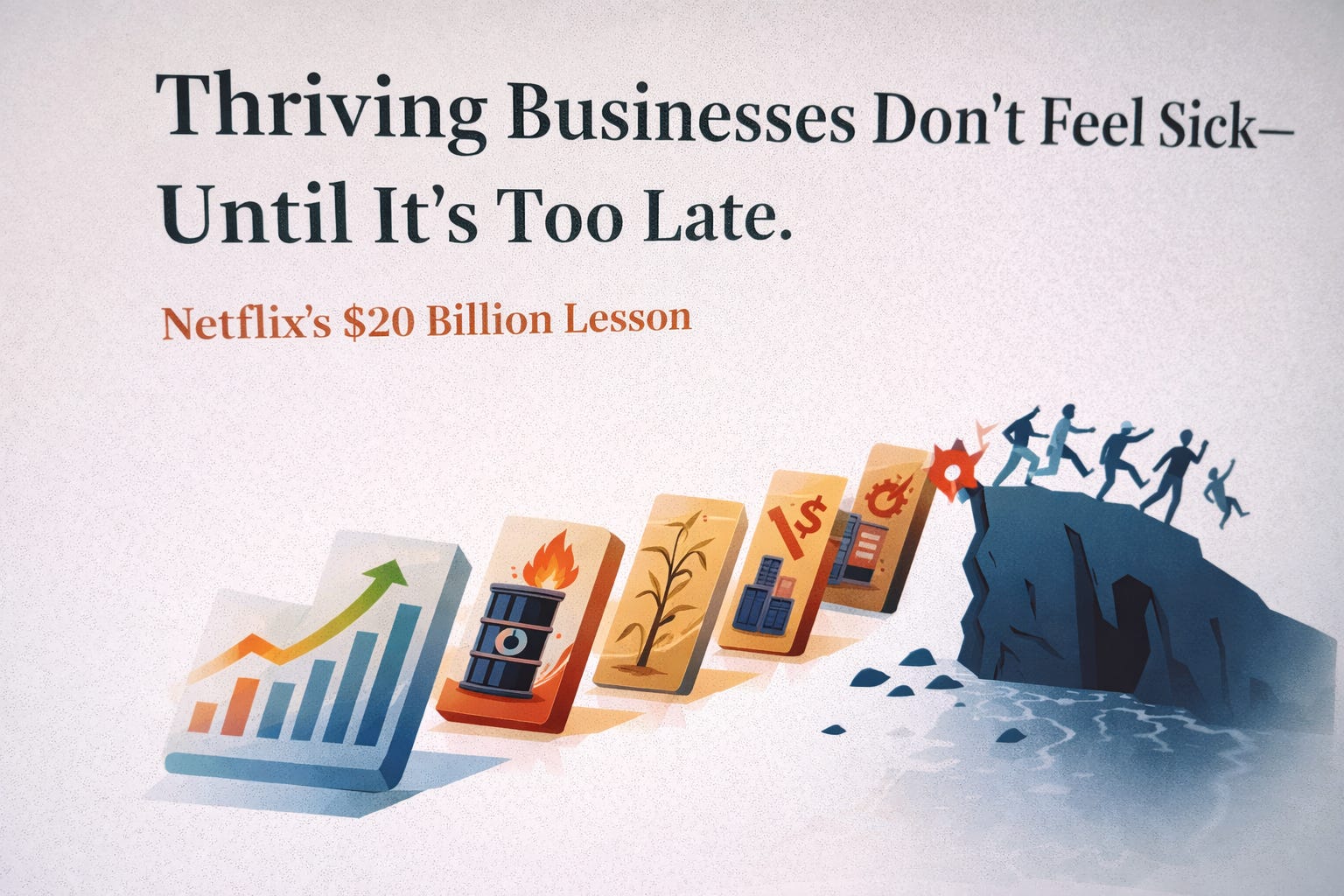
Late in 2007, Reed Hastings sat in Netflix’s headquarters, watching his DVD-by-mail business print money hand-over-fist. The company was profitable, growing, and dominating a market where Blockbuster was struggling. From the outside, everything looked perfect. But Hastings saw something others missed: the end of physical media was coming, and it was coming fast.
Against investor skepticism and the strong performance of their core business, Hastings launched Netflix Streaming with just 1,000 titles. Four years later, he tried an aggressive split, creating Qwikster as a separate DVD business. The customer backlash was immediate and brutal. Stock prices plummeted. Hastings reversed the decision but maintained his long-term commitment to streaming.
By 2019, Netflix had transformed completely: DVD‑by‑mail subscribers in the U.S. had dropped from a peak of tens of millions earlier in the decade to about 2.15 million, while global paying streaming subscribers had grown to roughly 167 million. The company that once risked disrupting its own DVD business became the streaming giant that disrupted everyone else.
The behavioral lesson here is profound: we diagnose disruption best when we’re not under pressure. Most leaders wait until crisis forces clarity—but by then, options are limited and costs are high. Netflix succeeded not because they predicted perfectly or executed flawlessly (Qwikster proved they didn’t), but because they diagnosed an uncomfortable truth while their DVD business was still thriving.
The Present Bias Trap
Humans—and organizations—suffer from present bias. We overweight current success and underweight future threats. When profits are strong, the whisper “everything is fine” drowns out the scream “change is coming”.
Netflix resisted this trap. They didn’t confuse “profitable today” with “sustainable tomorrow”. While competitors optimized their current models, Netflix diagnosed the future even when present performance suggested no urgency.
The Sunk Cost Fallacy
Companies cling to infrastructure they’ve built—DVD distribution centres, logistics systems, customer relationships—even when future demands require different capabilities. These sunk costs create gravitational pull toward the past.
Blockbuster couldn’t let go of their physical stores. Borders outsourced online to Amazon. Kodak invented digital photography but couldn’t let go of film. Blackberry couldn’t let go of enterprise customers or physical keyboards. Netflix recognized that their DVD infrastructure, while profitable, was becoming a liability.
The Confirmation Bias Echo Chamber
Success creates echo chambers. Leaders surround themselves with data that validates the current model, miss signals of disruption, and hire people who think the same way. The more successful you are, the more insulated you become from uncomfortable truths.
Netflix maintained diagnostic discipline even during their most profitable years. They asked “What would disrupt us?” when everything seemed fine. This is the leadership equivalent of preventive medicine—diagnose problems before they become crises.
The Status Quo Mentality
“If it ain’t broke, don’t fix it” is the enemy of innovation. This mentality prevents diagnostic honesty when business is performing well. Why disrupt what’s working?
Hastings famously said in 2005, “We named the company Netflix, not DVD-by-Mail”. This simple statement revealed his diagnostic clarity: they were always about entertainment delivery, not physical media. The method was secondary to the mission.
Loss Aversion Paralysis
The fear of cannibalizing profitable businesses prevents honest diagnosis about what the future demands. Netflix had to accept that streaming would eventually kill their DVD business—a loss they could prevent by embracing it first.
Most companies try to protect what they have instead of building what’s next. They optimize for today at the expense of tomorrow.
Leadership in the Diagnostic Age
The way to avoid this trap is to optimize diagnosis to be prepared for an uncertain tomorrow:
Diagnose during strength, not weakness. The capacity to see objectively—to diagnose what’s coming even when it contradicts what’s working—separates leaders who adapt from those who optimize themselves into obsolescence. As the old saying goes, you don’t fix a leaky roof in the middle of a thunderstorm.
Separate current performance from future viability. These are distinct questions. A business can be highly profitable today and completely unsustainable tomorrow. Leaders must learn to hold both truths simultaneously.
Accept diagnostic mistakes as learning. Qwikster failed, but Netflix learned about transition pace without abandoning their core diagnosis. Good diagnosis doesn’t mean perfect execution—it means staying committed to the truth even when execution falters.
Build diagnostic discipline into governance. Create regular strategic reviews that ask “What would disrupt us?” and “What reality are we avoiding?” Make diagnosis structural, not episodic.
Financial advisors often reinforce client biases (”your portfolio is fine”) rather than forcing honest diagnosis of risks, gaps, or needed changes. The greatest service you can provide is helping clients see what they’re avoiding.
For leaders, this means creating organizational cultures where uncomfortable truths can surface. When teams fear delivering bad news, silence becomes toxic. The most effective leaders cultivate psychological safety where data can challenge assumptions, where dissent is encouraged, and where early warning signals aren’t buried under optimism pressure.
Create metrics that force diagnosis. Track leading indicators of disruption (technology costs, bandwidth availability, customer behavior shifts) not just lagging indicators of current success. What you measure is what you pay attention to.
The Diagnosis Difference
Netflix succeeded because they diagnosed an uncomfortable truth while their DVD business was still thriving: physical media was dying, and streaming would replace it. Most companies fail this diagnostic test because success creates blind spots.
Current profits whisper “everything is fine” while future disruption approaches silently. The capacity to see objectively—to diagnose what’s coming even when it contradicts what’s working—separates leaders who adapt from those who optimize themselves into obsolescence.
Great diagnosis doesn’t guarantee perfect execution, but without it, execution becomes irrelevant. In a world of constant change, the leaders who win are those who can diagnose the future while enjoying the present.
This is the Uncertainty E.D.G.E.—not having perfect information but using the information you have with clarity and courage. Like Netflix diagnosing disruption while thriving, we must learn to see what’s coming even when everything seems fine.
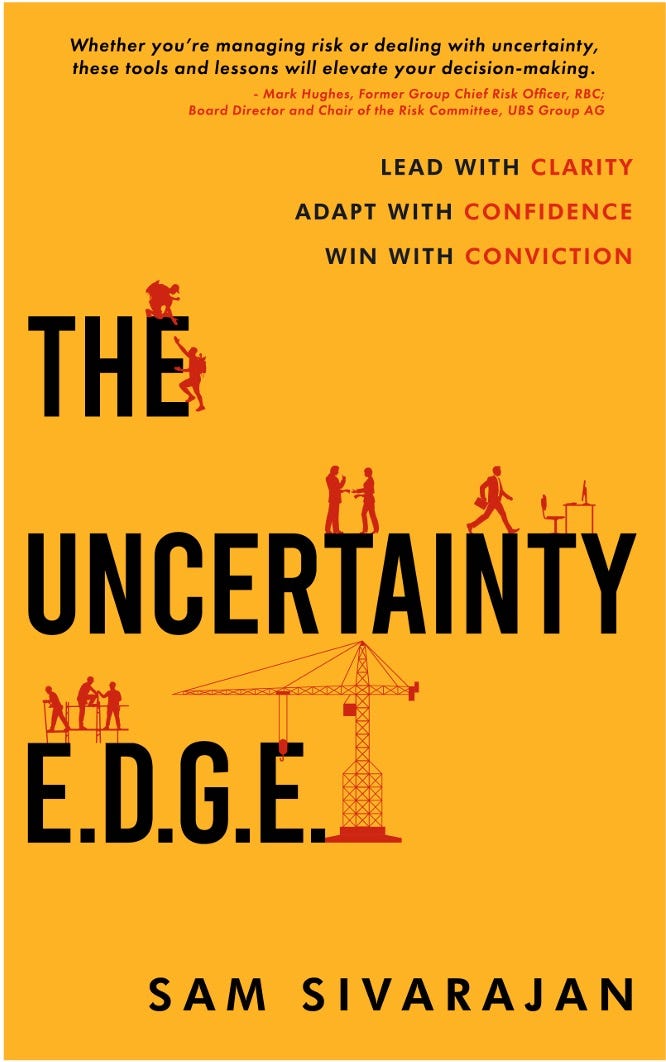
📖 Want to build diagnostic discipline into your leadership? My book The Uncertainty E.D.G.E. explores frameworks for seeing clearly when success creates blind spots. [Get your copy]
Here’s what one reviewer had to say:
Every risk professional knows: risk and uncertainty aren’t the same thing. This book provides the tangible, actionable framework to help master that difference. Through diverse real-world examples—both successes and failures—you’ll see exactly how to navigate uncertainty. Whether you’re managing risk or dealing with uncertainty, these tools and lessons will elevate your decision-making.
Mark Hughes | Former Group Chief Risk Officer, RBC | Board Director and Chair of the Risk Committee, UBS Group AG
🎙️ Go deeper: Earlier on The Uncertainty E.D.G.E. Podcast, I spoke with Philip Setter, who built a six-figure digital insurance business through content marketing. His videos started terribly—bad webcam quality, blank wall, no microphone—but he didn’t wait for perfect conditions. He started. And six months later, when traction came, he doubled down. Philip reveals three uncomfortable truths: you learn by doing, not researching; your niche isn’t a cage—it’s a spotlight; and intent creates authenticity. For professionals facing decisions where waiting feels as risky as acting: This episode shows what judgment looks like when certainty is impossible. [Listen to the full conversation with Philip Sutter]
© The Uncertainty E.D.G.E.™ | Published every other Tuesday
If this sharpened how you're thinking about a decision you're currently facing, forward it to someone carrying the same weight — and subscribe if you aren't already.
The Uncertainty E.D.G.E.™ is a biweekly newsletter on navigating consequential decisions when certainty isn't available.
Grounded in behavioral science and three decades of operating experience. No prediction. No false confidence. Just clearer judgment.
There is a quieter counterpart to this work. If you're also asking what it means to lead with purpose and character — not just clarity — I reflect on that separately in The Good Human Practice: thegoodhumanpractice.com