

What Kilimanjaro Taught Me About Goals
The Mountain Doesn’t Care How Fit You Are

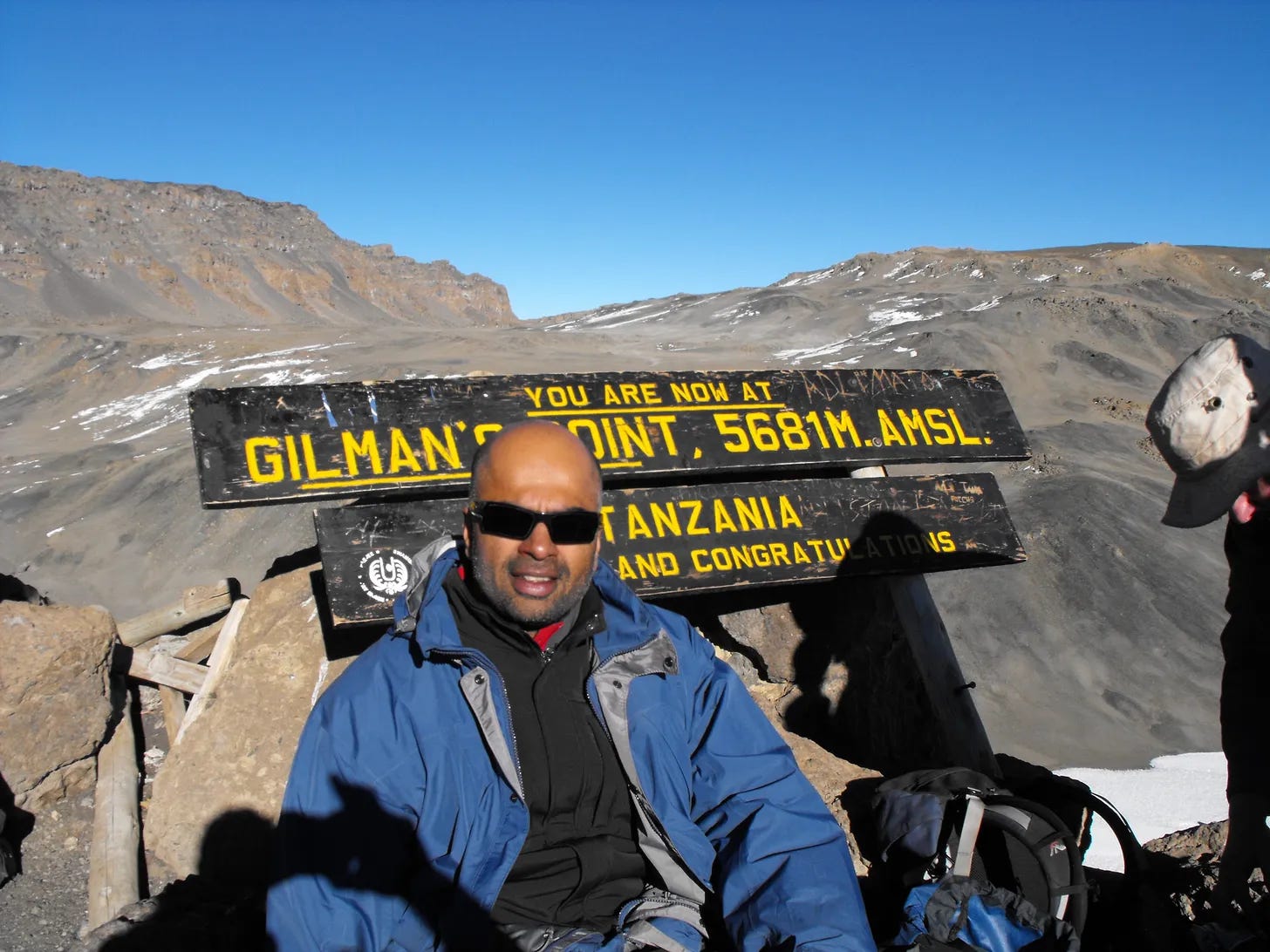
The fittest people failed on our way to the summit of Kilimanjaro. That’s when I realized: fitness isn’t the same as readiness.
This is a pattern I’ve noticed over many years of climbing mountains, advising leaders through change, and studying how people achieve meaningful goals: the direct path is rarely the best path.
Carl Friedrich Gauss discovered this in an 18th-century classroom.
Jack Welch realized it running GE.
I learned it at 19,000 feet (5,800 metres) on Kilimanjaro, watching two exceptionally fit marathoners fail to summit while the rest of us—moving slowly, deliberately—made it to the top.
The lesson we all learned? Achieving goals in the face of uncertainty demands an oblique approach.
The Problem with Going Straight Up
When Gauss’s teacher told his students to add up all the numbers from 1 to 100 and give him the final sum, he did it to keep them busy and get some quiet time. He expected them to plod through the arithmetic, and that it would take them a long time.
Gauss saw a different path. He immediately recognized the series as 50 pairs of 101 (1+100, 2+99, 3+98...) and simply calculated 50 × 101 = 5,050.
While his classmates were still on number 15, Gauss had the answer.
He didn’t solve the problem by powering through it. He solved it by stepping back to see the pattern.
This is what author John Kay calls obliquity—achieving complex objectives indirectly. As Kay writes: “Oblique approaches often step backward to move forward.”
“The most profitable companies are not the most profit-oriented,” Kay observes. “The happiest people are not those who make happiness their main aim.”
And I saw this principle play out in the thin air of Tanzania.
Poli, Poli: The Swahili Secret to Reaching the Summit
“Poli, poli”—slowly, slowly—is what every Kilimanjaro guide tells climbers. Not because the terrain is technically difficult (it isn’t), but because oxygen at the summit is one-tenth what it is at the base. Your body needs time to adapt and adjust.
On my climb, two incredibly fit climbers, marathoners back home, didn’t listen. They charged ahead every day, impatiently waiting for the rest of us to catch up. On summit day—the fourth day—altitude sickness hit them hard. They were bent over vomiting violently. They had to turn back. The summit was not in their cards.
Meanwhile, those of us who embraced “poli, poli”? We reached the summit.
The counterintuitive truth: going slower allowed us to go further.
This isn’t just about pacing. It’s about strategy. Climbing a mountain isn’t a straight line up.
You zigzag – i.e. you switchback.
You “climb high, sleep low”—ascending during the day, then descending 1,000 – 1,300 feet (300 – 400 metres) to camp at night.
Your body acclimatizes at the lower altitude, preparing you for the next push upward.
From the outside, it looks like you’re going backwards. But that nightly descent is what makes the summit possible.
Jack Welch understood this application in business.
The Dumbest Idea in the World
As GE’s CEO, Welch became Wall Street’s darling by creating unprecedented shareholder value. Yet in retirement, he told the Financial Times: “Shareholder value is the dumbest idea in the world.”
His reasoning? “You’ve got to deliver on short-range commitments, while you develop a long-range strategy and vision and implement it,” and “Balancing those two things is what management is.”
In other words, the route to sustainable profitability is oblique.
Focus directly on shareholder value, and you make short-sighted decisions. Focus on employees, customers, and long-term capability building, and shareholder value follows—indirectly.
The pattern holds across domains. Whether you’re climbing a mountain, building a business, or managing a portfolio, the direct pursuit of the goal often undermines the goal itself. Chase the metric directly, and you often get the opposite of what you want.
The E.D.G.E. Framework: Building Your Oblique Approach
This pattern—the power of indirect problem-solving—is embedded throughout the E.D.G.E. framework in my book The Uncertainty E.D.G.E.
Establish: Before chasing the summit (or returns, or market share, or any ambitious goal), establish your foundation.
What can you actually control?
What genuinely matters to long-term success?
What metrics truly indicate progress versus vanity metrics that look impressive but don’t drive decisions?
Sometimes you need to step back from execution to clarify strategy.
For financial advisors, this might mean pausing portfolio discussions to review client goals.
For product teams, it might mean slowing a launch to ensure the foundation is solid.
For leaders navigating organizational change, it might mean investing time in alignment before demanding action.
That feels like regression. But it’s actually essential foundation-building—the switchback that conserves energy for the climb ahead.
Diagnose: Like Gauss stepping back to see the pattern, diagnosis requires perspective. The Six Thinking Hats method forces you to examine decisions from multiple angles—facts, emotions, risks, opportunities, creativity, process. This feels slower than charging ahead with your gut instinct. But it prevents the mistakes that come from single-minded focus.
Go: Action matters. But smart action isn’t always fast action. “Poli, poli” got us to the summit while faster climbers turned back. The switchback conserves energy and allows the body to adjust.
The pre-mortem technique asks: “It’s 12 months from now and the decision I made today has failed completely. Why?” This backward look before moving forward reveals failure modes you would miss in the rush to act. Again, obliquity: stepping back to see what you’d miss going straight ahead.
The Small Wins Framework breaks overwhelming change into achievable steps. Each small win builds momentum and capability for the next.
This is the oblique approach to transformation: instead of the dramatic overhaul that rarely sticks, you create a series of small victories that compound into major change.
Evolve: Markets shift. Conditions change. Yesterday’s winning strategy becomes tomorrow’s losing one. The “climb high, sleep low” approach builds adaptability into the process. You don’t just push forward—you retreat, acclimatize, assess what’s working, then advance with greater capacity.
Mean reversion ensures that rigid adherence to past success eventually fails. Evolution requires the oblique approach: stepping back to learn, adjusting course, then moving forward with new capability.
The Power of Small Wins
Success, whether on the mountain, in the market, or in leadership, is a series of small wins.
When we set off for the summit on midnight of the 4th day on Kilimanjaro, it was pitch black. The idea was to climb through the night to be on the summit for sunrise. We had headlamps to light the way.
But, we couldn’t see more than 5 feet ahead. We certainly couldn’t see the summit.
That was ok. Because every step we took, the headlamps showed us another 5 feet ahead. Each step was a small win. And that small win showed us the next step, and the next step. In this way, we made the summit.
It’s the same in business. Launching a new initiative or transforming a business doesn’t have to be an all-out effort. In fact, it is usually better to aim for small wins. Each win provides more information, allows more time to get others on board, and it gather more resources and reveals more options. Best of all, it allows you to pivot or tweak your approach as the terrain or circumstances may dictate.
Why We Need Guides (Not Just on Mountains)
Our instincts betray us under pressure. When uncertainty rises, we want to go faster, push harder, take the direct route.
On Kilimanjaro, this impulse sends fit climbers back down the mountain.
In markets, it destroys meme stock chasers’ portfolios while rewarding investors with long-term patient capital.
In organizations, it leads to the short-sighted decisions Welch warned against.
This is where leadership—whether you’re guiding clients, managing teams, or navigating your own career—becomes essential. The best leaders help people (including themselves) overcome these instincts:
The urge to chase what worked last year instead of what fits the current situation
The desire to go faster when conditions get volatile
The impulse to focus on the destination instead of the process that gets you there
The temptation to skip foundation-building in favor of immediate action
Sometimes the best decision is the one that feels like delay: “Let’s step back first.”
For financial advisors, this might mean pausing portfolio discussions to clarify goals or rebuild a financial plan.
For business leaders, it might mean slowing a product launch to ensure the team is ready.
For anyone navigating a career transition, it might mean taking time to establish what you actually want before pursuing new opportunities.
These feel like setbacks. They’re actually switchbacks—the zigzag path that makes the summit achievable.
The Kilimanjaro guides know something crucial: reaching the top isn’t about fitness or speed. It’s about acclimatization.
You can’t rush adaptation. Your body needs time at each altitude to build the capacity for the next level.
The same is true for teams, portfolios, and personal growth.
You can’t skip the foundation and expect the structure to hold.
You can’t force adaptation by going faster.
The oblique path—stepping back, building capacity, then advancing—is often the only path that works consistently.
Your Oblique Path Forward
Whether you’re climbing a mountain, building a portfolio, leading a team, or navigating any form of uncertainty, the pattern holds:
The direct path forward is rarely the best path forward.
Step back to see the pattern, like Gauss did with his numbers.
Go slow to go far, like the Kilimanjaro guides teach.
Focus on the process that generates outcomes, not just the outcomes themselves, like Welch learned at GE.
Accumulate small wins, like our summit push demonstrated.
Build the foundation before the second story, like every successful long-term strategy requires.
Climb high, sleep low; advance, then retreat to build capacity, then advance further. This is how adaptation actually works.
Uncertainty doesn’t demand speed. It demands clarity. And clarity often comes from the oblique approach—the one that seems to step backward in order to move forward.
The two fit climbers who rushed ahead on Kilimanjaro were left watching from base camp as the rest of us—moving slowly, deliberately, obliquely—reached the summit and returned safely.
The lesson wasn’t about their lack of fitness. It was about their failure to respect the indirect path that high-altitude climbing demands.
What’s your equivalent of rushing straight up the mountain? What oblique path are you resisting right now? What “step backward” might actually be the key to moving forward?
This post draws on frameworks from The Uncertainty E.D.G.E.: Lead with Clarity, Adapt with Confidence, Win with Conviction. For the complete EDGE framework and implementation tools, [get the book ]
The Uncertainty Edge newsletter delivers frameworks like this every other Tuesday.