

What Were You Thinking? A Dot-Com CEO’s $64 Question
Why irrational exuberance doesn’t just misprice stocks — it writes your strategy for you

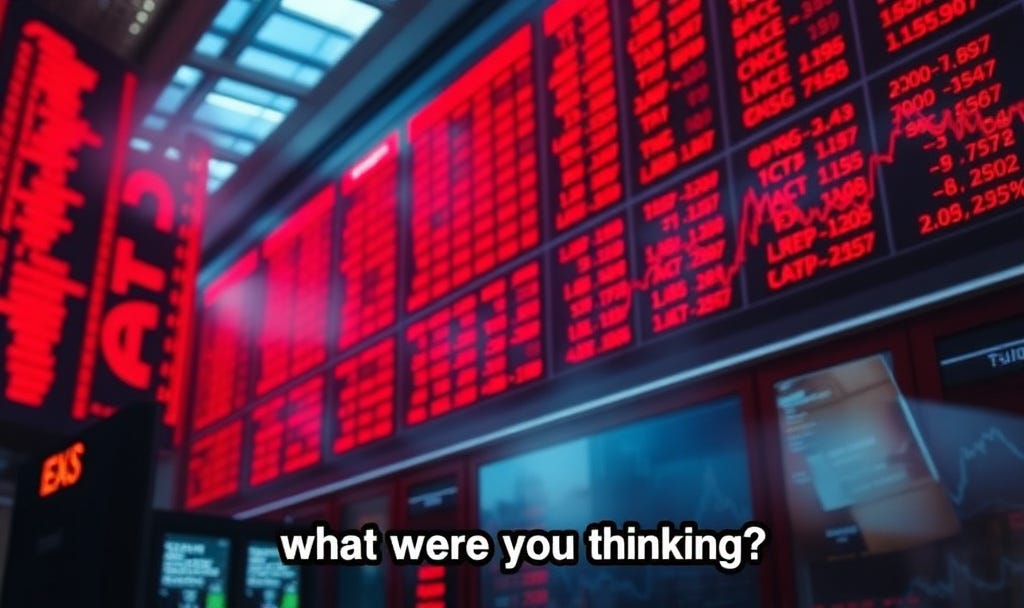
In 2002, with the dot-com wreckage still smouldering, Sun Microsystems CEO Scott McNealy was asked to make sense of the days when his own stock had traded at ten times revenue. The Sun share price had run from roughly $5 a share to $64 and back to single digits. He answered with arithmetic, not nostalgia. At ten times sales, he explained, to pay investors back he’d have to hand over every dollar of revenue as dividends for ten straight years: assuming zero cost of goods, zero expenses for 39,000 employees, zero taxes, zero research spending, and flat revenue the whole time. None of which is possible. Then he delivered the line that outlived the era: “What were you thinking?”
McNealy wasn’t defending his shareholders. He was gently mocking them and with the authority of a man who had watched the music stop. The math wasn’t sophisticated. It was the back-of-the-envelope check any careful buyer runs before paying a premium. The scandal was that at the peak, almost no investor ran it.
Here is the part that should concern operators, not just investors: exuberance of that magnitude never stays in the stock price. It leaks into the boardroom — changing what leaders build, what they buy, and how much they pay. The mispricing becomes a strategy.
When Exuberance Writes the Strategy
Every leader lives between hesitation and haste. Exuberance pushes hard toward haste; it makes waiting feel like losing and discipline feel like cowardice. McNealy’s question is a hesitation device disguised as a one-liner: it forces a pause long enough to ask what a price, a deal, or a capital plan actually implies about the future. Most leaders skip that pause, mistake the narrative for the numbers, and discover the difference only when the discount rate forces a recalculation. This issue is about installing the pause before the market installs it for you.
The dot-com bust is remembered as a stock-market event. It was also a graveyard of strategic decisions made by serious people at serious companies.
AOL–Time Warner, January 2000. Time Warner, a profitable empire of cable, film, and publishing, merged with AOL in a deal valued at about $165 billion, paid largely in AOL’s inflated stock. Within two years the company wrote down roughly $99 billion; real cash flows swapped for a multiple only the narrative could justify.
The telecom overbuild. WorldCom, Global Crossing, and others borrowed enormously to lay fibre against a forecast that internet traffic would double every hundred days. It didn’t. The capacity sat dark, the debt didn’t, and the bankruptcies followed in 2002; the companies that built on the story didn’t survive to collect.
WeWork, two decades later. A real-estate company with a software company rating reached a private valuation near $47 billion, fuelled by a backer’s conviction and the founder’s habit of reframing losses as growth. The much-anticipated IPO collapsed in 2019 the moment outside investors ran McNealy’s arithmetic on the prospectus.
Each was a strategic decision. A merger, a build-out, an expansion. And each was priced off a story rather than a payback. Exuberance didn’t just inflate a ticker; it set the agenda for what the company did next.
Why Smart Leaders Question the Math
These weren’t reckless people. They were experienced operators who, inside the narrative, found it harder to do nothing than to act. Several forces conspire:
Action bias. Under uncertainty, doing something feels safer than standing still. A bold acquisition signals conviction; restraint looks like you missed the plot.
Narrative fallacy. “We are buying the future of media / connectivity / intelligence” is a story that recruits everyone — the board, the press, the analysts. Spreadsheets don’t recruit. Stories do.
Social proof and FOMO. When peers are paying the premium and being rewarded for it in the moment, the cost of dissent is immediate and the cost of conformity is deferred. Loss aversion flips: the feared loss becomes “being left behind”, not “overpaying”.
Identity attachment. Leaders come to define themselves by the bet. Admitting the price was wrong means admitting they were wrong; so they double down.
McNealy’s point was never that his shareholders were stupid; it was that the supply of buyers willing to skip the arithmetic eventually runs dry, and the people running the companies were riding the same wave.
Here is why this matters today. The arithmetic is back, and its speed of return is its own warning. As of late October 2025, asset manager GMO calculated that companies trading above ten times sales made up more than 30 per cent of U.S. market capitalization. By June 2026, commentary citing Refinitiv data put the figure for the S&P 500 near 51 per cent. At the dot-com peak, roughly 29 companies in the index crossed that line, and it was read as collective insanity. Today, almost 40 companies meet that same criteria. Different decade. Same math — with Shiller’s cyclically adjusted P/E near 40 against a long-run average around 17, and the top 20 names now commanding more than half the index.
For operators, the relevant signal isn’t the multiple; it’s the spillover into strategic decisions across adjacent industries. The dot-com bust was largely confined to internet stocks; this time the premium has bled into the infrastructure beneath the story. Power producers like Vistra and Constellation, recently valued like the sleepy utilities they are, now trade as AI proxies. When a nuclear operator is priced like a semiconductor company, executives in power, real estate, and components start committing capital on the assumption the story holds. And that assumption deserves the McNealy treatment: Big Tech is on track to spend nearly $660 billion on AI this year, consulting company Bain estimates the industry needs roughly $2 trillion in annual revenue by 2030 to justify the build-out, and a widely cited MIT study found 95 per cent of companies have seen no measurable return from generative AI so far.
None of this proves AI doesn’t matter; the closest example may be the telecom and railroad build-outs, where the infrastructure eventually paid off. Bear in mind that the executives and investors who backed the infrastructure build usually lost everything. The operator’s question is whether the cash flows can grow into the prices and capital plans already committed. On Friday, June 5, the Nasdaq fell more than four per cent, its worst day since October, as long-term Treasury yields pushed back above five per cent and about a trillion dollars evaporated in days. The discount rate is the thing that ends these episodes, and it is moving.
The E.D.G.E. Framework: Running McNealy’s Math Before the Market Does
Establish: Separate the wave from the boat
You cannot control the market mania, the multiples, or what your competitors pay. You can control your own capital allocation, your balance-sheet exposure, and whether you let the narrative set your hurdle rate. Most leaders blur this line; they treat “the market expects it” as a fact about their own business.
Key question: Is this decision priced off my cash flows, or off someone else’s story about the future?
Diagnose: Do the arithmetic out loud
Run McNealy’s check on the bet in front of you. If the price implies a payback that requires zero competition, zero margin compression, and flawless execution for a decade, that’s not a forecast; it’s hope masquerading as strategy. Then separate real, paying demand from circular, vendor-financed demand: the 20 per cent that drives the outcome is the implied payback, not the slide that sells the vision.
Key question: If I handed this to a new CEO with no attachment to the story, what payback would they say this price assumes?
Go: Size the bet to survive being wrong
Purposeful action isn’t the same as standing still. Stage the commitment. Prefer reversible moves to irreversible ones. Keep enough balance-sheet slack that a rising cost of capital is an inconvenience, not an obituary. The leaders who survived the telecom build-out weren’t the ones who refused to invest — they were the ones who didn’t bet the company on demand that hadn’t arrived.
Key question: What’s the smallest version of this bet that captures the upside if the story is true; and survives if it isn’t?
Evolve: Decide your behavior in advance
The dot-com investors who blew up didn’t lack information; they lacked a pre-commitment. Decide now how you’ll act if interest rates keeps rising — which projects pause, which exposures you trim, what triggers a recalculation — rather than improvising mid-panic. Build it into governance: a standing review that asks, what reality are we avoiding because the story is still working?
Key question: Have we written down what we will do when the music slows? Or are we planning to improvise?
A Personal Note: The Deal That Didn’t Compute
Years ago, advising on a cross-border acquisition, I sat with a board that had fallen in love with a target. The logic was elegant, the management team charismatic, and a competitor was rumored to be circling; so the price kept climbing in the room before anyone had run a number.
I did something unwelcome. On a single page, I worked out what the offered multiple actually implied: the revenue growth, margins, and years of flawless integration the price was quietly assuming. Laid out plainly, the deal required the target to perform better than it ever had, every year, against a market getting more competitive, not less. It only worked if the story was true and stayed true.
We didn’t walk away; but we did restructure the offer so the upside was real and the downside survivable. We lost the bid. The competitor paid full freight, took the trophy, and spent years writing it down. The discipline wasn’t refusing to act. It was refusing to let the room’s excitement set the hurdle rate.
Ask the McNealy Question
Take the most exciting decision on your desk — the acquisition, the build-out, the expansion everyone agrees you “have to” make.
Step 1: Write the price or commitment at the top of a single page.
Step 2: Ask McNealy’s question: what would this have to return, every year, for the price to make sense? Write the implied payback explicitly.
Step 3: List what the story assumes — demand, competition, margins, timing — and mark which assumptions are facts and which are hopes.
Step 4: Pressure-test the demand. Is it real and paying, or circular, subsidized, or borrowed from a narrative you don’t control?
Step 5: Decide your trigger in advance; the condition under which you pause, restructure, or walk.
Sun’s old slogan was “We put the dot in dot com.” Its former headquarters now belongs to Meta. The buildings outlasted the irrational exuberance; and so does the question every leader should ask before the discount rate asks it for them:
What were you thinking?
© The Uncertainty E.D.G.E. | Published every other Tuesday
If this resonated, I’d love to have you as a free subscriber — and forward this to a leader who needs to see around corners.
The Uncertainty E.D.G.E. is for leaders who are accountable for outcomes they can’t fully control — and want a clearer way to think when certainty won’t come.
Essays and conversations on decision-making under pressure, every other Tuesday. Join me at theuncertaintyedge.com.
If the human side of leadership is what draws you, I also write The Good Human Practice — on inner clarity and character for leaders called on to make those hard decisions under pressure.