

When You Don’t Know Where to Start
The Discipline of Returning to Fundamentals

There is a moment most leaders know well, though few describe it openly.
It’s the moment when you are confronted with a problem so large, so complex, or so unfamiliar that your first instinct is not action but paralysis. You look at the numbers, the market shift, the strategic threat, the organizational dysfunction, and your mind screams: I don’t even know where to begin.
In those moments, intelligence can become a liability. The more variables you see, the more outcomes you imagine. You run the scenarios forward in your head and don’t like where they end. Before you have taken a single step, you are already attached to the outcome—and overwhelmed by it.
I learned this lesson in a very personal way many years ago.
When I was in my second year studying economics, I had to sit for an advanced mathematical economics exam. I remember walking into the exam room reasonably prepared, or so I thought. But when the paper was handed out and I flipped through the questions, something happened. I realized—at least in that first glance—that I couldn’t answer a single question.
Not one.
The questions looked foreign. Complex. Layered. I felt that unmistakable surge of panic. My internal narrative shifted quickly from “I’m prepared” to “I’m going to fail”.
For a few minutes, I did what most people do in that situation: I froze. I stared at the paper and imagined the outcome. I could see the poor grade. I could see the consequences. I could feel the implications.
Then, fortunately, something shifted.
Instead of trying to solve the entire problem I decided to write down what I did know. For each question, I began noting the relevant theory, the background concepts, the likely formulas that might apply. I wrote down definitions. I sketched out relationships between variables. I didn’t yet have the answer, but I had fragments.
Slowly, as I did this, the next step came to me. Then another. A piece of algebra here. A substitution there. An insight about how two variables interacted.
It wasn’t dramatic. It was incremental.
But in that incremental way, I worked through each question. And when the results came back, I had done surprisingly well—far better than I believed possible in those first few panicked minutes.
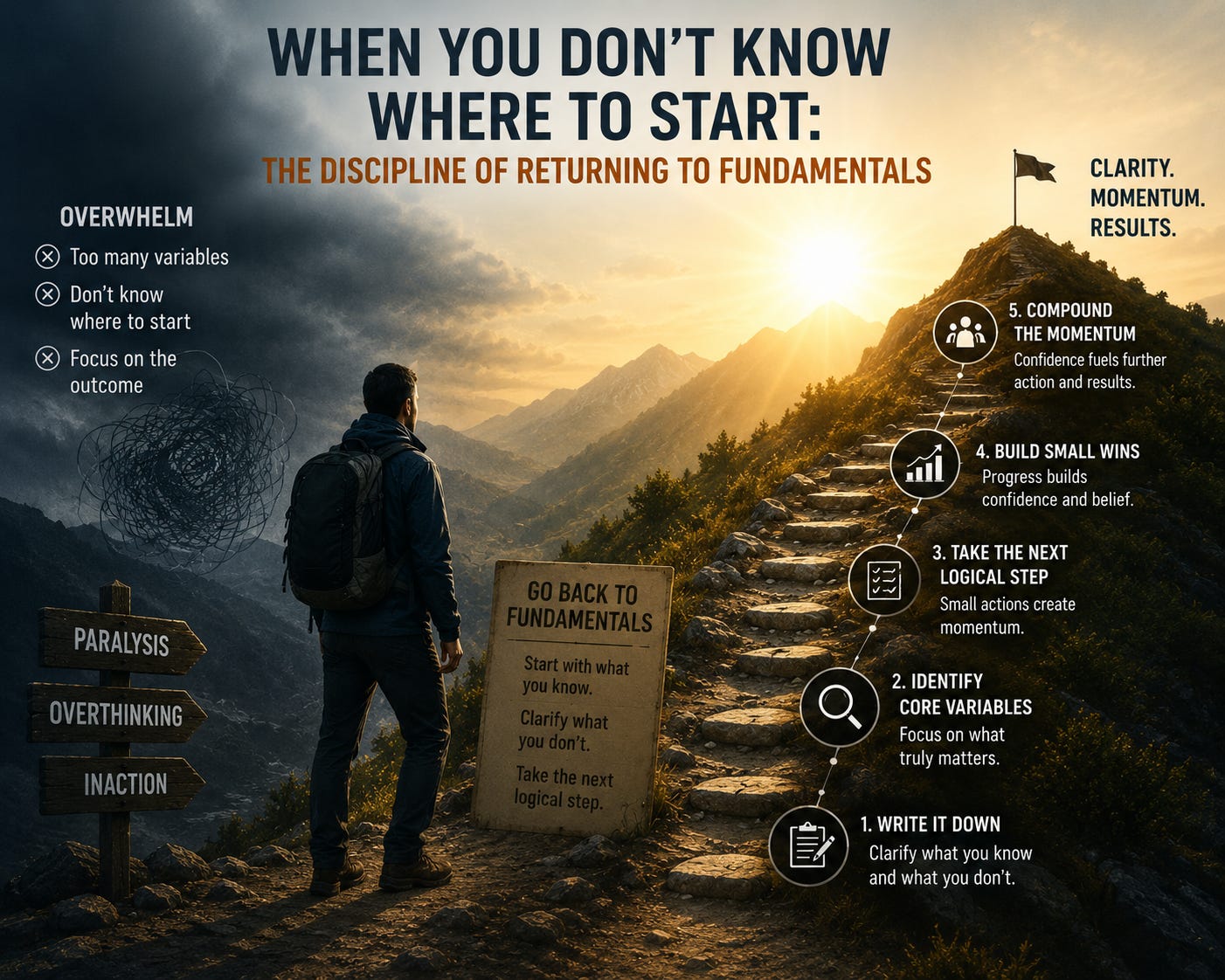
That exam became a powerful leadership lesson for me. When you don’t know how to solve the whole problem, return to fundamentals. Start with what you know. Clarify what you don’t. Then take the next logical step.
Pretty soon, you will find your way.
The Executive Version of Exam Panic
In business, the equivalent of that exam moment happens more often than we like to admit.
A quarterly miss shakes investor confidence. A competitor launches a disruptive product. A regulatory shift threatens margins. A key team member resigns unexpectedly. Technology changes faster than your systems can handle.
You look at the landscape and think: This is too big.
I was reminded of this recently in a conversation with a senior executive whose company had just missed projections significantly. When I asked what had happened, he didn’t blame the environment. Instead, he said, “We didn’t want to stress our employees or hold them accountable for meeting agreed targets. We thought being employee-first meant avoiding tough conversations.”
He then reflected on something deceptively simple: “Remember BEDMAS from school? The order of operations for solving math problems? You can’t do addition before multiplication and expect the right answer. In business, we tried to focus on the feel-good additions before ensuring the fundamentals were solid. It ended up catching up with us.”
His comment speaks to sequence, yes. But it also speaks to something deeper. When we are overwhelmed, we often reach for what feels more comfortable rather than what is foundational.
In this executive’s case, difficult accountability conversations felt uncomfortable. So, they were deferred. Cultural emphasis replaced operational rigor. But avoiding the first hard step didn’t remove the pressure; it merely postponed it, and in doing so, magnified it.
This is what overwhelm does. It distorts priorities.
Why Overwhelm Leads to Inaction
When leaders feel overwhelmed, three patterns typically emerge.
First, they fixate on the outcome. They imagine the worst-case scenario and allow it to dominate their thinking. Like my initial reaction in that exam hall, they see failure before they see process.
Second, they assume the solution must be equally large. If the problem is enterprise-wide, the solution must be a sweeping transformation. If the market threat is existential, the response must be revolutionary.
Third, they delay starting because they cannot see the full path to the solution.
But complex systems, whether mathematical models or large organizations, rarely yield to sweeping gestures. They respond to disciplined and consistent engagement with fundamentals.
The law of small wins operates here with quiet power. When you break a large, intimidating challenge into smaller, manageable actions, you reduce cognitive load.
You create traction. And perhaps most importantly, you rebuild belief.
You galvanize resources.
You see possibilities.
Progress generates confidence. Confidence fuels further action. Action compounds.
Back to Fundamentals: A Practical Framework
So, what does “going back to fundamentals” look like in practice for executives?
It begins with intellectual honesty.
In that exam hall, my first honest admission was this: I do not currently know how to solve this entire question. My second was more empowering: I do know the underlying principles.
In business, the equivalent might sound like this:
We cannot fix the entire organization this quarter.
We cannot outspend our competitors overnight.
We cannot eliminate uncertainty.
But:
We can understand our unit economics clearly.
We can identify which clients, products, or divisions are profitable.
We can clarify decision rights and accountability.
We can address one broken process.
We can have one overdue performance conversation.
The fundamentals are rarely glamorous. They are often operational, sometimes tedious, occasionally uncomfortable. But they are controllable.
This is where the BEDMAS metaphor from grade school remains useful—not as a rigid formula, but as a reminder. In arithmetic, brackets define the structure of the problem. In business, core operations and economic reality define the structure. Exponents multiply impact; in business, that is your competitive advantage. Division and multiplication reflect resource allocation. Addition and subtraction resemble cultural programs, benefits, and initiatives.
If you attempt to add before you stabilize the brackets, the equation fails.
But here is the key: you don’t need to fix the entire bracketed expression at once. You simplify it step by step.
The Power of Writing It Down
One subtle but important aspect of my exam experience was physical engagement. I stopped staring at the problem and started writing.
There is something powerful about moving from mental rumination to tangible action. Writing down what I knew transformed the problem from an abstract threat into a structured challenge.
Executives can apply the same discipline.
When facing a daunting strategic issue, instead of debating endlessly at a high level, write down:
What do we know for certain?
What assumptions are we making?
What data do we lack?
What are the core variables driving this outcome?
Which of those variables can we influence directly?
This exercise alone often reduces anxiety. It turns an emotional reaction into analytical engagement.
From there, the next step often becomes visible.
Small Wins as Antidote to Organizational Paralysis
In organizations, overwhelm spreads quickly. If the senior team feels stuck, that feeling cascades downward. Meetings become circular. Initiatives stall. Energy dissipates.
Small wins counteract this.
They are not cosmetic victories or public relations exercises. They are real, measurable improvements in areas that matter. A tightened forecasting process. A clarified pricing model. A renegotiated supplier contract. A focused product redesign. A streamlined approval chain.
Each small win sends a signal: We can move this.
That signal changes behavior.
Teams that believe progress is possible behave differently from teams that believe decline is inevitable. The former experiment, engage, and contribute ideas. The latter protect themselves.
Momentum, once established, becomes self-reinforcing.
Compassion and Accountability Are Not Opposites
One of the more subtle lessons in all of this is that compassion and accountability are not opposing forces. In fact, they depend on each other.
Leaders who avoid difficult conversations in the name of empathy often discover that the long-term result is greater pain—missed targets, restructuring, layoffs, reputational damage.
Conversely, leaders who ground their organizations in clear expectations, disciplined operations, and transparent metrics create a form of stability that reduces anxiety. People understand what is required. They see the connection between effort and outcome. They trust the system.
This is what sustainable leadership looks like: not harshness, not softness, but sequencing. Fundamentals first. Then amplification.
The Question That Changes Everything
If you find yourself—or your organization—overwhelmed by the scale of the challenge ahead, resist the temptation to search for a sweeping solution.
Instead, ask a simpler question:
What do we know?
What is fundamental here?
What is the next logical step?
Not the final answer. Not the five-year vision. The next step.
In that exam hall years ago, I was convinced I was going to fail because I could not see the end. The turning point came when I stopped trying to see the end and focused on the first line of work in front of me.
Leadership is not so different.
The world is complex. Markets are volatile. Organizations are imperfect. You will not always see the full path forward. I was reminded of this basic fact of life years ago when I made my summit attempt on Kilimanjaro. After four days of climbing, we started our summit push at midnight aiming to be on the top for sunrise. In the pitch dark, you could not see the summit; you only saw 5 feet ahead, in the glow from your headlamps. But every step you took, more of the path was revealed. In this way, we made the summit without ever seeing the full path.
The same applies in life and in business. If you focus on fundamentals—if you start with what you know, clarify what you don’t, and take the next disciplined step—progress often reveals itself.
And once progress begins, overwhelm recedes.
Pretty soon, you will find your way.
© The Uncertainty E.D.G.E. | Published every other Tuesday
If this resonated, I’d love to have you as a free subscriber — and forward this to a leader who needs to see around corners.
The Uncertainty E.D.G.E. is for leaders who are accountable for outcomes they can’t fully control — and want a clearer way to think when certainty won’t come.
Essays and conversations on decision-making under pressure, every other Tuesday. Join me at theuncertaintyedge.com.
If the human side of leadership is what draws you, I also write The Good Human Practice — on inner clarity and character for leaders called on to make those hard decisions under pressure.
This is an important article, and a thought-provoking one. It merits more than just one reading. And it leads me to a consideration of Canada's current healthcare 'system'. It is a disaster, a fact that it recognized by its supposed architects, its managers and its users. The fundamental problem? No-one knows where to start.